 how-to
Buy a Durable Campfire Grill for Backcountry Trips
Table of Contents
- What Makes a Campfire Grill Durable Enough for the Backcountry?
- Best Materials for Open-Fire Cooking: Carbon Steel vs. Cast Iron vs. Stainless
- Lightweight vs. Heavy-Duty Camping Grills: What to Prioritize
- Key Features to Look for in a Durable Campfire Grill
- How to Clean Burnt Camping Cookware in the Field
- Field Repairability and Long-Term Wear: A Buying Checklist
- Our Pick: The ANVIL Adjustable Campfire Grill
- Frequently Asked Questions
Last Updated: September 9, 2026
When you buy a durable campfire grill for backcountry trips, the decision comes down to one question: will it survive the abuse of remote travel and open flame, or will it fold after a season? A durable campfire grill is the difference between a reliable cooking platform and a bent piece of wire you strap to your pack for another hundred kilometers. At Browns Outpost, we offer heavy-duty open-fire cooking gear, and the advice below reflects what actually holds up miles from the nearest hardware store.

Most guides treat grill buying like a spec sheet comparison. The real issue is simpler: weight, material, and repairability. Get those three right and you will cook over fires for decades.
What Makes a Campfire Grill Durable Enough for the Backcountry?
Backcountry durability is not the same as backyard durability. A grill that sits on a patio deck never gets lashed to a pack, dropped on granite, or exposed to temperature swings from freezing rain to roaring flame. In the backcountry, a durable campfire grill must survive repeated thermal cycling from direct heat, physical abuse during transport, and corrosion from moisture and ash.
The frame and legs take the worst of it. Thin stamped steel bends when you set a loaded pot down too hard. Welded joints crack after repeated heating and cooling. The cooking surface warps when one side gets direct flame while the other stays cool. A grill that handles these conditions needs material thickness, not clever design.
Best Materials for Open-Fire Cooking: Carbon Steel vs. Cast Iron vs. Stainless
Each material brings different trade-offs for heat distribution, weight, and corrosion resistance. Carbon steel is the standout for backcountry grills because it combines the heat retention of cast iron with a thinner profile that keeps weight manageable. Cast iron offers unmatched thermal conductivity and heat distribution but adds significant pack weight. Stainless steel resists corrosion best but often uses thinner gauge material that warps under direct heat.
| Material | Heat Distribution | Weight | Corrosion Resistance | Best For |
|---|---|---|---|---|
| Carbon Steel | Excellent | Moderate | Good with seasoning | Backcountry grills, versatile use |
| Cast Iron | Superior | Heavy | Requires maintenance | Basecamp cooking, skillets |
| Stainless Steel | Good | Light | Excellent | Wet environments, minimal care |
Carbon steel also develops a natural seasoning over time, creating a food-grade, non-stick surface that improves with each use. Cast iron does the same but at nearly double the weight for the same surface area. For a grill you carry on your back, carbon steel is the practical choice.
Lightweight vs. Heavy-Duty Camping Grills: What to Prioritize
The lightweight vs heavy-duty camping grills debate forces a real trade-off, but the decision framework changes entirely when you factor in how you actually travel. Ultralight titanium grills shave grams but flex under heavy loads and transfer heat unevenly. Heavy-duty carbon steel grills add pack weight but provide a stable, load-bearing cooking surface that handles a full cast iron pan or a large roast.
Here is the concrete math most guides skip. A typical ultralight titanium grill weighs between 200 and 400 grams (7 to 14 oz) and packs down to the size of a paperback book. A heavy-duty carbon steel grill like the ANVIL weighs roughly 2.5 kg (5.5 lb) and folds to the size of a small cutting board. That difference of about 2 kg (4.5 lb) is the equivalent of carrying an extra liter of water or a full day of food.
But weight is only half the equation. A 200-gram titanium grill might save your back on the approach, but if it cannot hold a loaded pot without sagging, you will spend your evening managing a wobbly cooking surface instead of eating. The ANVIL handles 40 lb or 20 kg without issue, which covers everything from a full deer quarter to a loaded Dutch oven.
Think about what you actually cook. If you only boil water and rehydrate meals, a thin folding grill is fine. If you cook fresh meat, vegetables, or multi-course meals over the fire, you need a surface that holds steady weight without sagging.
For most backcountry users, the real question is not "how light can I go" but "how much cooking performance am I willing to trade for pack weight." If you build a fire every evening and cook a proper meal, the extra 2 kg is the best weight you will carry.
Key Features to Look for in a Durable Campfire Grill
When you buy a durable campfire grill for backcountry use, focus on the features that determine long-term survival. Adjustable height matters more than most buyers realize. Being able to raise or lower the grate lets you dial in exact heat over any fire, from a roaring blaze to a bed of coals. Fixed-height grills force you to manage the fire around the grill, which is far harder.
Look for a cooking surface that is large enough for real meals. A 15 x 20 inch or 38 x 50 cm grate gives you room for multiple pans or a full roast. Foldable legs reduce packed size for transport. Carbon steel is a suitable material for cooking. And a design that works over any open fire, whether a firepit, campsite ring, or backcountry fire grate, adds versatility that cheap grills cannot match.
How to Clean Burnt Camping Cookware in the Field
Knowing how to clean burnt camping cookware in the field separates experienced backcountry cooks from frustrated ones. The method is simple: scrape off food residue while the grate is still warm, then burn off remaining debris over the fire. Never use soap on seasoned carbon steel or cast iron, as it strips the protective layer.
For stubborn burnt-on food, heat the grate until residue turns to ash, then scrape with a metal spatula or grill brush. Wipe down with a cloth and apply a thin layer of cooking oil while the metal is warm. This maintains the seasoning and prevents rust during transport. If you are heading into wet conditions, pack the grill in a dry bag with a light oil coating to keep corrosion at bay.
But cleaning your grill is only half the story. Food scraps, grease, and ash do not belong in the fire ring or scattered around your campsite. They attract wildlife, disrupt soil chemistry, and leave visible evidence of your stay. The Leave No Trace Center for Outdoor Ethics recommends packing out all food waste, including the charred bits you scrape off your grill (lnt.org).
The practical method is to carry a small, dedicated stuff sack for grill cleaning. After you scrape the grate, collect the residue in that sack and pack it out with your trash. This adds maybe 100 grams to your pack but keeps your campsite clean and wildlife-safe. For grease, let it cool and solidify, then wipe it into the same sack. Do not pour it on the ground or into the fire; it will leave a stain and attract animals for days.
Where you clean your grill matters too. If you are in a designated fire ring, the ash stays contained. If you are building a fire on bare ground, most backcountry regulations require fire pans or established rings to protect the soil. The cleanest approach is to scrape over a flat rock or a piece of foil that you can fold up and pack out.
After a thorough burn-off and scrape, your carbon steel grate will look dry and gray. That is normal. Apply a thin coat of cooking oil while the metal is still warm, not so much that it drips, but enough to give the surface a slight sheen. This layer protects against moisture and forms the base of your next cooking session.
Field cleaning is not just about keeping your gear functional. It is about leaving the backcountry as you found it.
Field Repairability and Long-Term Wear: A Buying Checklist
Repairability is the most overlooked factor when you buy a durable campfire grill for backcountry expeditions. A grill that cannot be fixed in the field is a liability. Look for designs where the grate, legs, and adjustment mechanism can be serviced with basic tools.
Use this checklist before you commit to a purchase:
- Material thickness: 3 mm or heavier carbon steel resists warping
- Welded or bolted joints that can be repaired, not riveted
-
- Adjustable height mechanism that operates without tools
- Surface area of at least 15 x 20 inches for real meals
- Weight capacity above 20 kg for loaded cookware
- Replacement parts available from the manufacturer
Long-term wear shows up first at the edges of the grate and the hinge points. Inspect these areas before each season. A grill backed by a lifetime warranty removes the risk of premature failure.
Our Pick: The ANVIL Adjustable Campfire Grill
For most backcountry cooks, the ANVIL Adjustable Campfire Grill from Browns Outpost is the best option on the market. It pairs a heavy carbon steel grate with an adjustable height mechanism that works over any open fire. The 15 x 20 inch or 38 x 50 cm surface handles 40 lb or 20 kg with no problem, and the raw carbon steel builds a natural seasoning that improves with every trip.
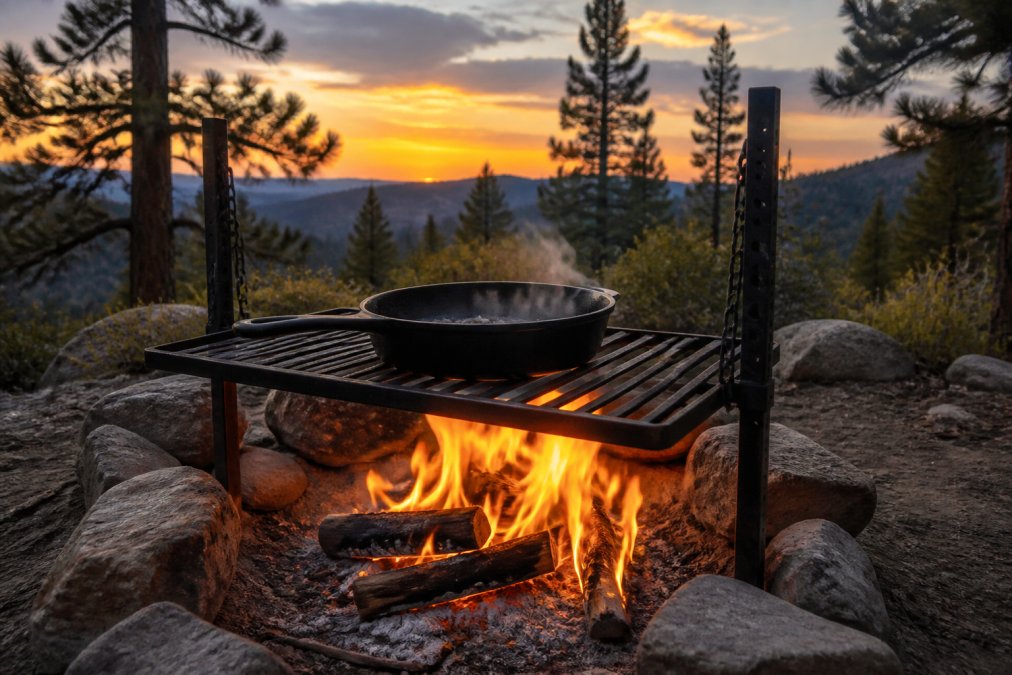
At $174.99 CAD, that price buys a lifetime warranty, free shipping over $75 CAD, and a piece of gear built for tough, durable construction.
The one limitation is weight. At roughly the size of a small cutting board when folded, it is not an ultralight option for minimalist backpackers. But for anyone who prioritizes cooking quality and durability over saving a few hundred grams, it is the right call.
Choosing gear for the backcountry means planning for the worst conditions, not the best ones. A grill that bends under load, rusts in damp weather, or cannot be repaired in the field will fail when you need it most. The ANVIL Adjustable Campfire Grill from Browns Outpost offers heavy carbon steel construction, an adjustable height mechanism, and a lifetime warranty. Get started with Browns Outpost and cook over an open fire with gear built for a lifetime.
Frequently Asked Questions
Is carbon steel better than stainless steel for campfire cooking?
For a durable campfire grill, yes. Carbon steel offers superior heat distribution and a non-stick surface over time, similar to cast iron but lighter. Stainless steel resists rust better but often has hot spots and doesn't sear as well. A raw carbon steel grill, like the ANVIL, develops a natural seasoning that improves with each use, making it a top choice for open-fire cooking.
What features make a campfire grill durable for backcountry use?
Look for a grill made from heavy-gauge carbon steel or cast iron with a load-bearing frame. Adjustable height is critical for controlling direct heat as the fire burns down. The cooking surface should be food-grade and large enough for your pot or pan. A stable, wide base prevents tipping on uneven ground, and a simple, welded design means fewer parts to break.
Are heavy-duty campfire grills worth the extra weight for backpacking?
For backpacking, a lightweight titanium or thin stainless steel grill is practical. For canoe trips, base camps, or hunting camps, a heavy-duty grill is worth the weight. It offers a larger cooking surface, better heat retention, and stability for heavy cast iron cookware. If you are carrying a 10-inch cast iron pan, you need a grill that can support it without bending.
How do I maintain a raw carbon steel grill in the backcountry?
After cooking, burn off food residue over the fire. Once cool, scrape off any remaining bits with a metal spatula. Wipe the surface with a paper towel to remove moisture. If you can, apply a thin layer of cooking oil before packing it. At home, clean it with hot water and a stiff brush, dry it thoroughly, and re-season to prevent rust.