 listicle
Best Carbon Steel Pan for Campfire Cooking in Canada
Table of Contents
- What Makes a Carbon Steel Pan Right for Campfire Cooking
- Carbon Steel vs Cast Iron for Camping: Which One Wins
- Top Carbon Steel Pans for Campfire Cooking Available in Canada
- Browns Outpost Handcrafted Carbon Steel: Built for the Fire
- Lodge Seasoned Carbon Steel Skillet: Accessible and Proven
- De Buyer Mineral B Element: French Precision Over Flame
- Made In Carbon Steel Frying Pan: Lightweight High-Heat Performance
- Matfer Bourgeat Black Steel: Professional-Grade Durability
- How to Season a Carbon Steel Pan for Camping
- Maintaining Carbon Steel Cookware in Humid Conditions
- Where to Buy Carbon Steel Pans in Canada
- Conclusion
Last Updated: August 9, 2026
Carbon steel is the most underrated material in outdoor cooking, and Canadian campers are finally catching on. At Browns Outpost, we've tested cookware that holds up to open flames, unpredictable weather, and backcountry abuse. This guide covers the best carbon steel pans for campfire cooking in Canada, with honest assessments of what performs over live fire and what falls apart in tough conditions.
Carbon steel heats fast, handles direct flame without warping, builds a natural non-stick patina through polymerization, and weighs significantly less than cast iron. For Canadian campers dealing with cold mornings, damp conditions, and long pack-ins, that weight-to-performance ratio matters more than most reviews acknowledge.
Quick Picks:
- Best Overall: Browns Outpost Handcrafted Carbon Steel - purpose-built for open-fire cooking with a lifetime warranty
- Best Budget Entry: Lodge Seasoned Carbon Steel Skillet - pre-seasoned and widely available across Canada
- Best for Serious Cooks: De Buyer Mineral B Element - French-made precision with exceptional patina development
- Lightest High-Heat Option: Made In Carbon Steel Frying Pan - pre-seasoned, fast-heating, grill-safe to high temperatures
- Professional-Grade Pick: Matfer Bourgeat Black Steel - rivet-free construction, 3mm thick, built to last decades
What Makes a Carbon Steel Pan Right for Campfire Cooking
Carbon steel is a high-carbon iron alloy (98-99% iron, 1-2% carbon) that combines steel's thermal conductivity with durability for high-heat outdoor cooking. Unlike stainless steel, it responds quickly to temperature changes. Unlike cast iron, it's light enough to carry.
Not every carbon steel pan belongs over a campfire. The differences between a pan that thrives on open flame and one that warps or rusts come down to specific construction details.
Gauge Thickness, Warp Resistance, and Open Flame Safety
Gauge thickness is the single most important spec for campfire use. Pans under 2mm thick warp when exposed to uneven, intense wood fire heat. A minimum of 2.5mm is workable; 3mm is standard for serious outdoor use. Thicker steel distributes heat evenly and resists thermal shock.
Pans stamped from a single sheet of steel without welds or rivets hold their shape better under stress. Riveted handles become weak points over repeated heating and cooling cycles on open flame.
Handle ergonomics matter outdoors. A long handle keeps hands away from fire but adds weight and packability issues. Many camp cooks wrap a silicone sleeve around the handle or carry a cloth to protect their hands.
Backpacking vs. Car Camping: Weight Thresholds That Matter
The right carbon steel pan depends entirely on how you're getting to camp.
| Use Case | Recommended Weight | Minimum Thickness | Priority |
|---|---|---|---|
| Backpacking (pack-in) | Under 600g | 2mm | Packability |
| Canoe tripping | Under 900g | 2.5mm | Balance of weight and durability |
| Car camping | Under 1.5kg | 3mm | Heat retention and durability |
| Base camp / hunt camp | Weight flexible | 3mm+ | Performance and longevity |
For backpacking in Canadian terrain, a 20cm pan in the 500-600g range is the practical ceiling. For car camping, weight becomes irrelevant and you should prioritize a 3mm or thicker pan.
Carbon Steel vs Cast Iron for Camping: Which One Wins
Cast iron wins on heat retention and performs better over a dying fire. Carbon steel wins on almost everything else: it heats faster, responds better to temperature adjustments, weighs 30-50% less, and develops an equally effective non-stick patina with proper seasoning. Over an open flame with uneven heat, carbon steel's faster thermal conductivity gives you more control.
For cold-weather performance, cast iron has an edge. In temperatures well below freezing, its thermal mass keeps it hot longer between additions. For winter camping or early-season hunting trips in northern Ontario or BC, this matters.
For three-season camping and most backcountry use, carbon steel is the better choice.
Outdoor cooking equipment guidance from Parks Canada
Top Carbon Steel Pans for Campfire Cooking Available in Canada
Carbon steel skillets perform differently over an open flame than on a kitchen stove. The pans below were evaluated specifically for campfire use: warp resistance, handle safety, seasoning retention after wet conditions, and packability for Canadian outdoor environments.
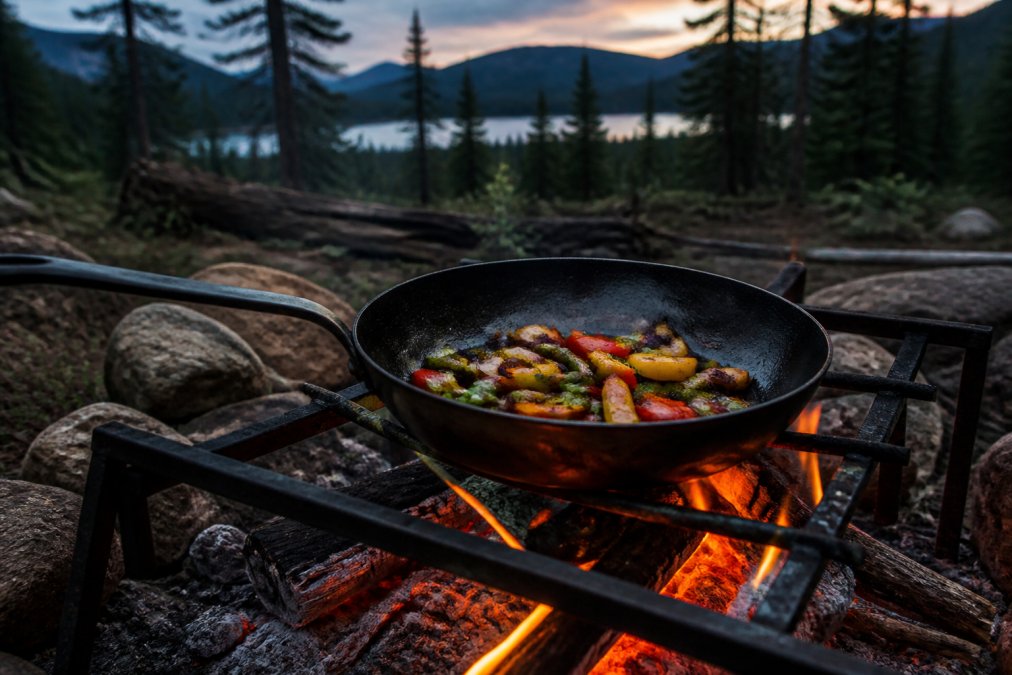
Browns Outpost Handcrafted Carbon Steel: Built for the Fire
Browns Outpost is our top pick for campfire cooking in Canada. The handcrafted raw carbon steel construction is purpose-built for over-the-fire cooking in a way mass-produced pans aren't. The lifetime warranty separates Browns Outpost from every other option. For cookware facing campfires, pack-outs, and Canadian winters, that warranty is a genuine assurance of durability. The ANVIL adjustable campfire grill system pairs directly with the carbon steel cookware, giving you precise height control over flame.
Customer Dan D. said: "This grill has completely changed over-the-fire cooking for me. I have never had a grill this strong and durable, it's super versatile and easily holds an entire rear quarter from a deer."
Free shipping is available on orders over $75 CAD.
Best for: Serious outdoor cooks, hunters, and campers who want professional results over a campfire and expect their cookware to last a lifetime.
Pros:
- Handcrafted raw carbon steel built for open-flame use
- Lifetime warranty
- Pairs with the ANVIL adjustable campfire grill for precise heat control
- Free shipping over $75 CAD
- Rated 4.93/5 across 97 verified reviews
Cons:
- Available exclusively through brownsoutpost.com; not stocked in retail stores
Lodge Seasoned Carbon Steel Skillet: Accessible and Proven
Lodge is the most accessible carbon steel option for Canadian buyers. You can find it at Canadian Tire, sporting goods retailers, and major online platforms, which matters when you need a pan before a trip.
The pre-seasoned surface, finished with 100% natural vegetable oil, means you can use it straight out of the box. Heat retention is solid for a campfire pan, and it handles direct flame without complaint. The honest limitation: Lodge carbon steel runs heavier than many alternatives at comparable sizes. For car camping, it's a reliable workhorse.
Best for: Car campers and cottage-goers who want a proven, widely available carbon steel skillet.
Pros: Pre-seasoned and ready to use, excellent heat distribution, grill-safe and oven-safe, widely available across Canada
Cons: Heavier than comparable carbon steel options, requires re-seasoning to maintain non-stick properties over time
De Buyer Mineral B Element: French Precision Over Flame
De Buyer's Mineral B Element rewards patience. The beeswax coating protects against oxidization and kickstarts the seasoning process. The heavy-quality iron construction and thick skirt design give excellent warp resistance over uneven flame. Once a proper patina develops, food release is exceptional.
De Buyer requires careful maintenance: hand-wash only, dry immediately, and apply a thin oil coat after every use. In humid Canadian camping conditions, skipping this step results in surface rust faster than expected.
Best for: Enthusiasts who want to develop a high-performance patina over time and don't mind the maintenance discipline.
Pros: Beeswax coating aids initial seasoning, excellent browning and caramelization, durable high-heat construction
Cons: Requires careful hand-washing and oiling after each use, handle gets hot during prolonged cooking
Carbon steel cookware safety and material standards overview
Made In Carbon Steel Frying Pan: Lightweight High-Heat Performance
Made In's carbon steel frying pan is manufactured in Sweden and rated for open flame use at extremely high temperatures. For campfire cooking where temperatures spike well above kitchen stove levels, that rating matters. The pre-seasoned surface performs well immediately, and the lighter construction makes it practical for canoe tripping or portaging.
The faster heat response that makes it great for campfire cooking requires attention. Over a very hot flame, it heats faster than most cooks expect, and burning food is easier than with a thicker pan.
Best for: Cooks who want a lightweight, high-performance pan for both backcountry trips and indoor cooking.
Pros: Lighter than cast iron with faster heat response, pre-seasoned, rated for open flame use at high temperatures, induction compatible
Cons: Faster heating requires careful flame management, higher price point than entry-level options
Matfer Bourgeat Black Steel: Professional-Grade Durability
Matfer Bourgeat's Black Steel pan is the choice of professional kitchen brigades across France and increasingly across North America. The 3mm thick single-plate carbon steel construction delivers exceptional heat retention, and the rivet-free welded handle eliminates the most common failure point in campfire cookware.
No rivets means no crevices where food, moisture, and bacteria accumulate. Over a campfire, it also means no weak points that expand and contract unevenly with thermal cycling. The natural non-stick surface that develops with seasoning is among the best in class.
Best for: Serious outdoor cooks and hunters who want professional-grade durability and are willing to invest in proper initial seasoning.
Pros: 3mm thick construction for excellent heat retention, rivet-free design for durability and hygiene, exceptional non-stick surface once seasoned
Cons: Requires thorough initial seasoning, handle conducts heat significantly during campfire use
| Pan | Thickness | Weight Class | Best Use | Canadian Availability | | --- | --- | --- | --- | | Browns Outpost | Handcrafted | Car camping / hunt camp | Open-fire cooking | brownsoutpost.com | | Lodge Carbon Steel | Standard | Car camping | All-purpose campfire | Canadian Tire, major retailers | | De Buyer Mineral B | Heavy gauge | Car camping | Searing and browning | Specialty kitchen stores | | Made In Carbon Steel | Mid-gauge | Canoe / car camping | High-heat versatility | madeincookware.ca | | Matfer Bourgeat Black Steel | 3mm | Car camping / base camp | Professional durability | Specialty importers |
How to Season a Carbon Steel Pan for Camping
Seasoning a carbon steel pan bonds thin layers of polymerized oil to the steel surface to create a natural non-stick finish and protect against corrosion. Each layer builds on the last, and the pan's food release improves with every use.
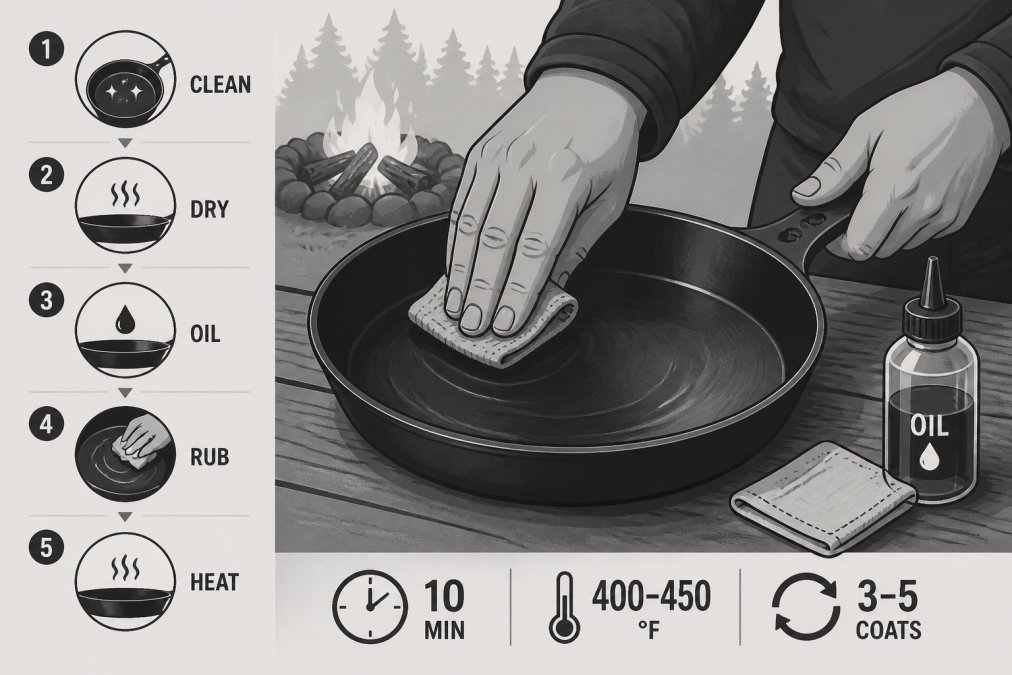
For campfire seasoning, the process differs slightly from stovetop seasoning because the heat source is less controlled:
- Clean the pan - Scrub off any factory coating or rust with hot water and a stiff brush. Dry completely over low heat.
- Apply a very thin oil layer - Use a high smoke point oil: flaxseed, grapeseed, or refined coconut oil. Wipe the entire surface, then buff off almost all of it. The layer should look nearly dry.
- Heat over the campfire - Place the pan over moderate coals and heat until it begins to smoke. The oil polymerizes and bonds to the steel.
- Let it cool, then repeat - Allow the pan to cool slightly, apply another thin layer, and heat again. Two to three rounds builds a solid initial patina.
- Cook fatty foods first - Bacon, sausage, or anything with natural fat reinforces the seasoning faster than any other method.
The most common mistake is applying too much oil. A thick layer doesn't polymerize evenly; it pools and creates sticky patches that take multiple cooks to correct.
Cold-Weather Seasoning: What Changes Below 5°C
Below 5°C, oil viscosity increases and the pan takes longer to reach polymerization temperature. Pre-warm the pan over the fire before applying any oil. When a hot pan cools rapidly in cold air, moisture can form on the steel surface. Always apply a thin protective oil coat before storing a pan overnight in cold conditions.
Maintaining Carbon Steel Cookware in Humid Conditions
Maintaining carbon steel cookware in humid conditions is the biggest practical challenge for Canadian outdoor cooking. British Columbia's coastal rainforest, Ontario's humid summers, and the persistent dampness of canoe country all create conditions where carbon steel rusts faster than most buyers expect.
Carbon steel must never be stored wet. After every use, rinse with hot water, dry immediately over heat, and apply a thin coat of oil before the pan cools. For multi-day camping trips in humid conditions, the oil coat applied at the end of each day is non-negotiable. Use whatever cooking oil you have on hand. A paper towel or cloth is sufficient. The goal is a microscopically thin barrier between the steel surface and moisture in the air.
According to Outdoor Council of Canada's backcountry gear maintenance recommendations, moisture management is the leading cause of premature gear degradation on Canadian backcountry trips, and cookware is among the most commonly affected items.
Repairing Rust After Wet or Damp Camping Trips
Surface rust on a carbon steel pan is fully reversible. For light surface rust (orange-brown discoloration, no pitting):
- Scrub with a steel wool pad or coarse salt and a cloth until the rust is gone
- Rinse with hot water and dry immediately over heat
- Apply a thin oil layer and heat until it smokes
- Repeat the seasoning process two to three times to restore the patina
For deeper rust or rust that's been sitting for weeks:
- Soak the affected area briefly in a mixture of water and white vinegar (no more than 30 minutes)
- Scrub aggressively with steel wool
- Rinse, dry completely over heat, and re-season from scratch
The key difference between a pan worth saving and one that isn't is pitting. Surface rust removes cleanly. Pitting means the steel itself has been compromised, and no amount of seasoning will restore a smooth cooking surface.
Where to Buy Carbon Steel Pans in Canada
Browns Outpost ships directly to Canadian addresses with free shipping on orders over $75 CAD. For buyers who want handcrafted carbon steel built specifically for campfire use, brownsoutpost.com is the direct source.
Canadian Tire stocks Lodge carbon steel in most locations and online. It's the most accessible entry point for buyers who want to handle a pan before purchasing.
Specialty kitchen retailers (kitchen supply stores in major Canadian cities) typically carry De Buyer and Matfer Bourgeat. Stock varies by location, so calling ahead is worth doing.
Made In Cookware ships directly to Canada through madeincookware.ca.
For buyers in remote areas, ordering online well in advance is the reliable approach. Import duties on cookware from non-CUSMA countries can add meaningful cost. Buying through a Canadian retailer or a brand with Canadian fulfillment avoids this entirely.
Choosing the right carbon steel pan for campfire cooking in Canada comes down to how you camp, where you camp, and how much maintenance you're willing to commit to. Browns Outpost handcrafted carbon steel, backed by a lifetime warranty and built specifically for open-fire cooking, is the strongest choice for Canadian outdoor enthusiasts who want professional results over a campfire without replacing their cookware every few seasons. The ANVIL adjustable campfire grill pairs directly with the carbon steel for precise flame control. Visit brownsoutpost.com to add it to your kit before your next trip.
Frequently Asked Questions
Is carbon steel better than cast iron for campfire cooking?
Carbon steel heats faster and responds more quickly to temperature changes than cast iron, which makes it easier to control cooking over an unpredictable open flame. It is also lighter, so carrying it to a backcountry site is less demanding. Cast iron holds heat longer once hot, which suits slow cooking. For most campfire tasks, searing, frying, and sautéing, a carbon steel pan offers a better weight-to-performance ratio, especially on multi-day trips.
Are carbon steel pans safe for direct campfire flames?
Yes. Carbon steel pans are grill-safe and open flame compatible because they are made from tempered steel with no synthetic coatings that could burn off or release harmful residue. Pans rated for direct flame use, including those with welded or riveted handles, handle the heat well. Avoid pans with plastic or composite handle components. Always check the manufacturer's temperature rating, and use a heat-resistant glove since handles get very hot over an open fire.
How do you season a carbon steel pan for outdoor use?
Start by washing off any factory coating or beeswax with hot water and a stiff brush. Dry the pan completely, moisture causes oxidization. Apply a very thin layer of high-smoke-point oil, such as flaxseed or grapeseed oil, across the entire surface. Heat the pan over your campfire or camp stove until the oil smokes and polymerization occurs, then let it cool. Repeat three to five times to build a durable, non-stick patina. In cold weather, warm the pan slightly before applying oil so it spreads evenly.
How do you clean a carbon steel pan after camping?
While the pan is still warm, wipe out food residue with a paper towel or cloth. For stuck food, add a small amount of water and heat briefly to loosen it, then scrape with a wooden or metal spatula. Avoid soap, which strips the seasoning. Rinse with hot water and dry immediately and thoroughly, air drying in humid Canadian conditions invites rust. Once dry, rub a light coat of oil over the surface before storing. Never leave a carbon steel pan wet.
Where can I buy high-quality carbon steel pans in Canada?
Browns Outpost offers handcrafted carbon steel cookware built specifically for open-fire use, with free shipping on orders over $75 CAD and a lifetime warranty. Larger outdoor and kitchen retailers across Canada also stock options from various brands. Buying from a Canadian-based retailer avoids cross-border shipping delays, import duties, and currency conversion costs, particularly useful if you need gear before a scheduled trip into the backcountry.
This article was written using GrandRanker