 listicle
Best Heavy Duty Campfire Cooking Gear 2026: Top Picks
Table of Contents
- What Makes Campfire Cooking Gear Heavy Duty?
- The ANVIL: A Heavy Duty Adjustable Campfire Grill
- Best Cast Iron Cookware for Campfire Cooking
- How to Clean Burnt Camping Cookware
- Weight vs. Durability: Is Heavy Duty Gear Worth It?
- Long-Term Care and Repairability
- Conclusion
- Frequently Asked Questions
Last Updated: September 14, 2026
What Makes Campfire Cooking Gear Heavy Duty?
Heavy duty campfire cooking gear is equipment built from thick-gauge materials, typically cast iron or heavy carbon steel, that can withstand direct flame, coal contact, and repeated thermal cycling without warping or degrading. The defining traits are material thickness, heat retention, and construction that assumes abuse rather than careful handling.
At Browns Outpost, we build our entire line around that standard: hand-crafted raw carbon steel and cast iron, backed by a lifetime warranty. Most gear fails because thin steel buckles under high heat or coatings flake off after a season. Heavy duty means the opposite: the pan gets better with use, not worse.
Below, we'll break down what separates real heavy duty campfire cooking gear from the disposable stuff, and which pieces earn a permanent spot in your kit.
The ANVIL: A Heavy Duty Adjustable Campfire Grill
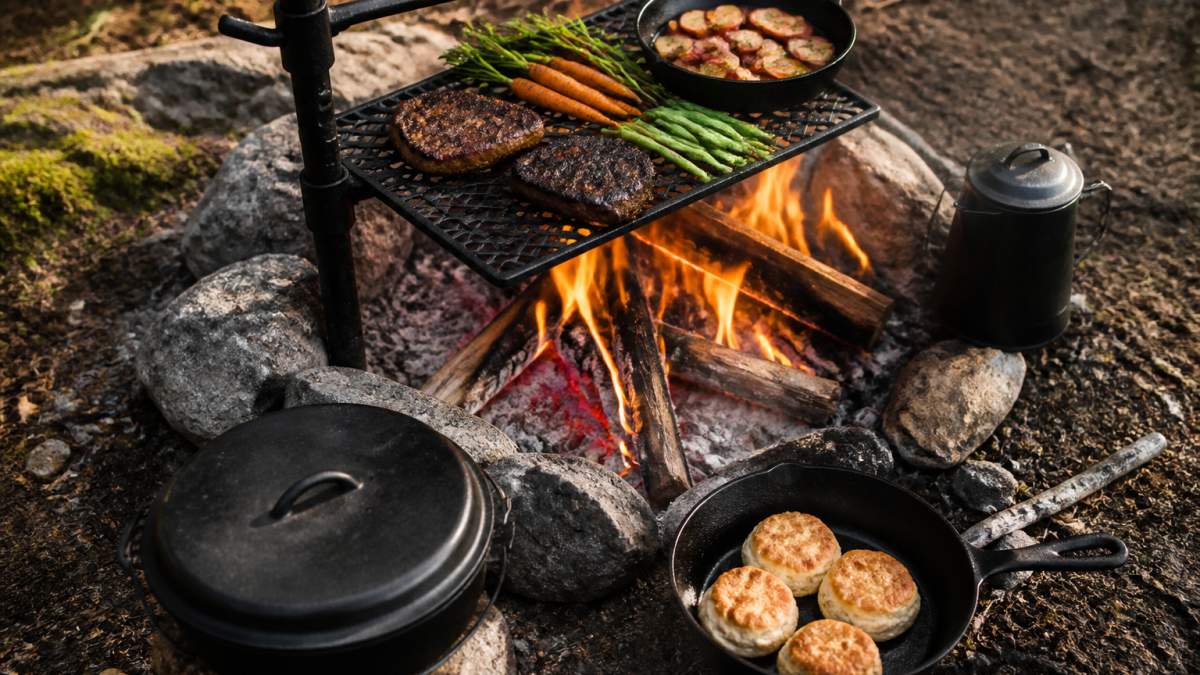
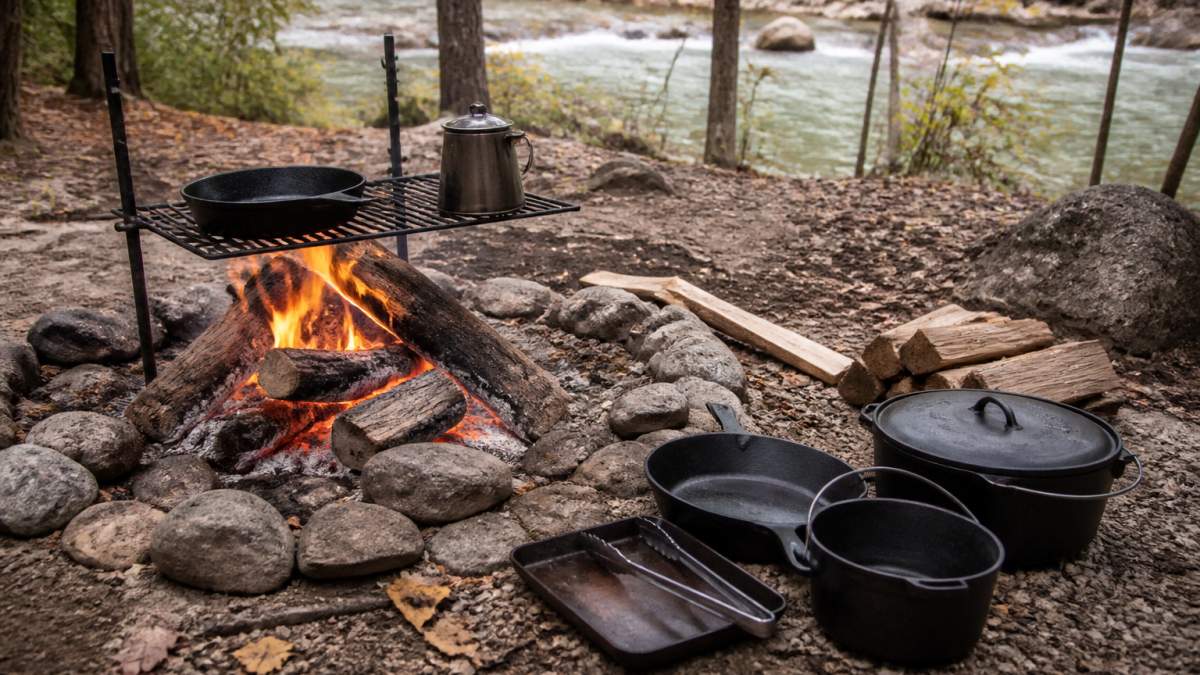
The ANVIL is a heavy duty adjustable campfire grill with 38 x 50 cm of carbon steel grilling surface, a variable-height stake system, and a 16.5 lb build that handles up to 20 kg without flexing. It stakes into the ground over any fire pit, campsite ring, or backyard bonfire.
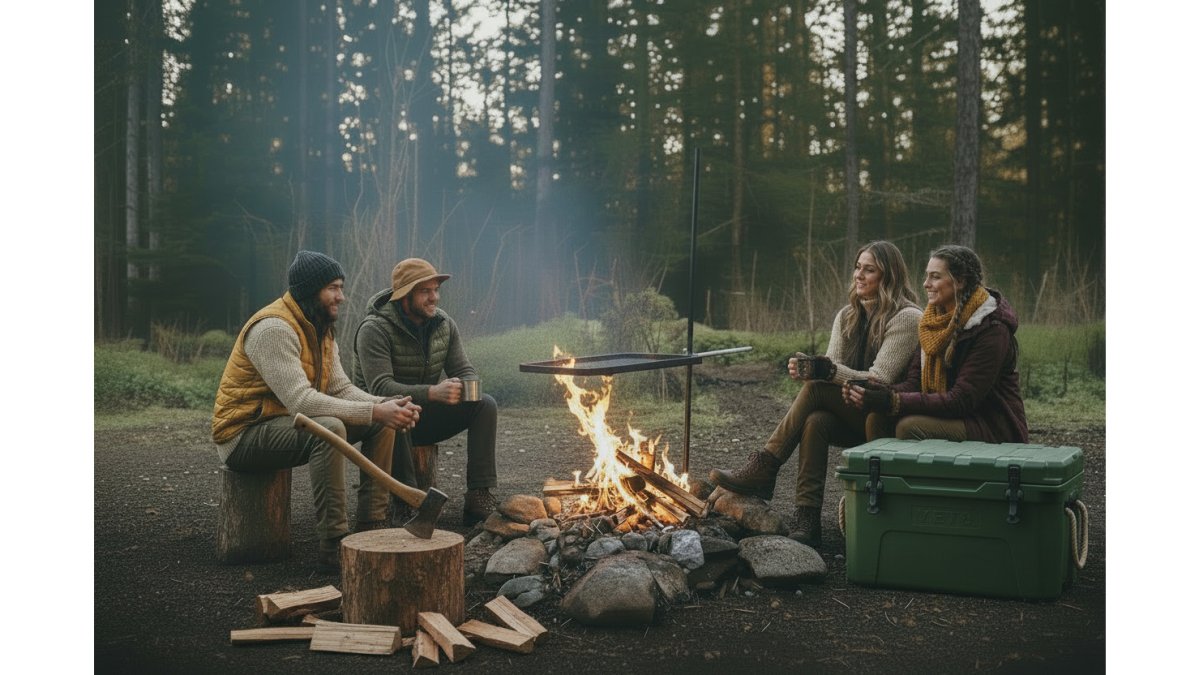
What sets it apart is the height adjustment. The grate slides and locks along the stake, so you raise it for high heat or drop it low for a slow cook. One grill replaces a tripod, a separate sear station, and a lighter-duty grate.

It packs down flat with no case required, which matters when packability competes with weight-to-durability ratio.
At $174.99, the ANVIL is the piece that anchors a serious open-flame setup. A customer put it plainly: "I have never had a grill this strong and durable, it's super versatile and easily holds an entire rear quarter from a deer."
Best Cast Iron Cookware for Campfire Cooking
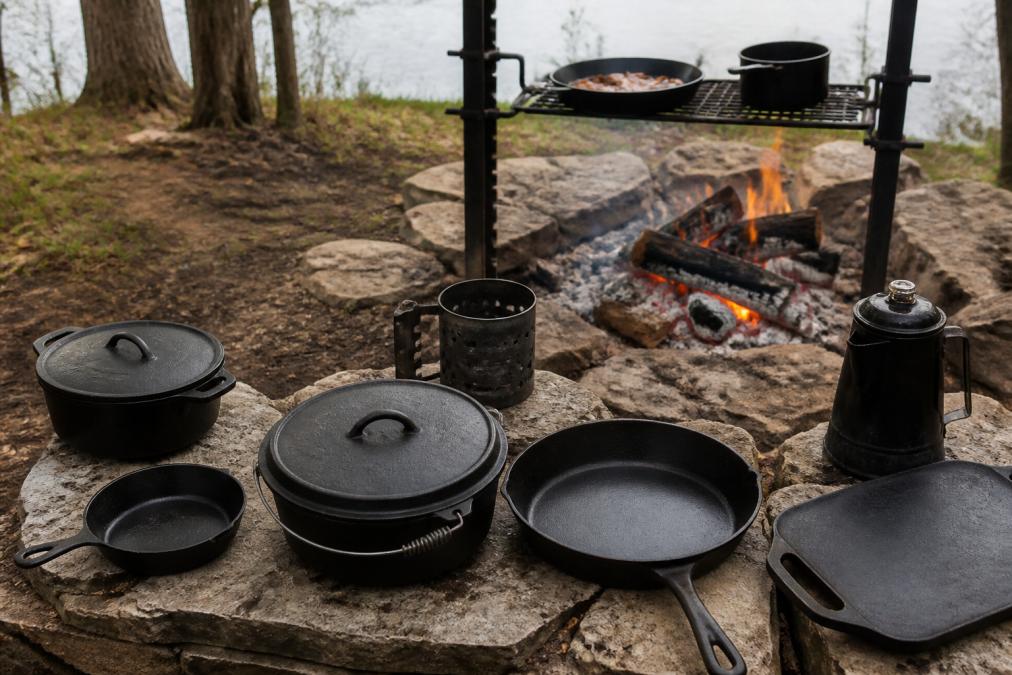
Cast iron wins on heat distribution and thermal conductivity: thick walls spread heat evenly so nothing scorches on one side. Every piece below is cast heavy on purpose, works over coals, grill grates, or a home stovetop, and carries the same lifetime warranty.
| Piece | Size | Price | Best For |
|---|---|---|---|
| 12" Dutch Oven | 30.5 cm | $52.99 | Braises, stews, camp-oven bread for 4-6 |
| 16"×9" Griddle | 40.6 x 22.9 cm | $37.99 | Camp breakfast for a crowd |
| 10" Cauldron w/ Reversible Lid | 25.4 cm | $45.99 | One-pot meals, lid doubles as griddle |
| 12" Roasting Pan | 30.5 cm | $48.99 | Steakhouse sear, pan sauces |
| 10" Shallow Skillet | 25.4 cm | $32.99 | Fast breakfasts, everyday searing |
| 3-Piece Fry Pan Set | 10", 8", 6" | $47.99 | Every size, nests for packing |
| 8" Dutch Oven w/ Lid | 20.3 cm | $45.99 | Minimalist and two-person trips |
| 7.5" Sauce Pan w/ Lid | 19 cm | $37.99 | Sauces, sides, slow simmers |
The 12" Dutch Oven is the workhorse: a flanged lid holds coals for genuine camp-oven baking. For groups, the griddle cooks pancakes, eggs, and bacon at once instead of one skillet at a time. The cauldron's reversible lid flips into an extra flat cooking surface.

How to Clean Burnt Camping Cookware
Campfire heat is harder on cookware than a kitchen range. Direct flame and glowing coals push surface temperatures well past what a stovetop burner reaches, and that intensity is what carbonizes residue into a black, bonded layer that a normal wash won't touch (according to Health Canada's cooking safety guidelines). Cleaning burnt camping cookware is really two jobs: routine cleanup after a normal cook, and restoration after a genuinely burnt-on or fire-damaged session. Treat them differently.
Routine cleanup after a normal cook
- Burn it off. Return the pan to the fire and let residue carbonize, then brush it out while warm.
- Deglaze. Pour hot water into the warm pan and simmer for two to three minutes to lift stuck food.
- Scrape gently. Use a wooden spatula or stiff brush. Skip steel wool on seasoned surfaces.
- Dry on heat. Set the pan back over the fire until every trace of water evaporates. Rust starts in seconds on a wet pan.
- Re-oil. Wipe a thin coat of neutral oil across the whole surface, inside and out, while it's still warm.
That sequence handles 90% of trips. The other 10% is where campfire cooking diverges from kitchen cooking, and where most guides stop short.
Fire-specific restoration: when the fire wins
A long braise over coals, a windy night that drives flame up the sides, or a forgotten pot can leave a pan with three distinct problems that routine cleaning won't fix:
- Carbonized crust, a hard, matte black shell that feels like sandpaper and won't scrub off with a brush.
- Flaked or patchy seasoning, the polymerized oil layer lifts in sheets, usually on the hottest zone of the pan.
- Flash rust, orange surface rust that appears within hours on any bare spot left damp.
Each has a specific fix.
For carbonized crust: don't attack it with steel wool, which gouges the metal and strips good seasoning around the burn. Instead, build a lye-free soak: fill the pan with water, add a few tablespoons of baking soda, and simmer it over the fire or a camp stove for 15-20 minutes. The alkaline water softens the carbon layer so a wooden scraper lifts it in sheets. Repeat once if needed. This is slower than sanding but preserves the seasoning you've built.
For flaked seasoning: you don't need to strip the whole pan. Scrub only the flaked zone back to bare grey metal with a scouring pad, dry it on heat, and re-season just that patch. A thin coat of oil, heated until it smokes and then cooled, rebuilds the layer. Two or three patch-seasoning cycles blend the repair into the surrounding surface.
For flash rust: this is the most common campfire problem and the most reversible. Scrub the rust back to bare metal with steel wool or a scouring pad; this is the one time steel wool is the right tool, because there's no seasoning left to protect. Dry the pan immediately over heat, then run a full re-season: thin oil, heat to smoking, cool, repeat three times. A rusted pan is not a ruined pan.
The fire-specific seasoning rule
Most practitioners find that campfire seasoning builds differently than oven seasoning. Oven seasoning cures evenly at a controlled temperature; fire seasoning cures in patches, because the pan sits over uneven heat. That's fine, it just means you should rotate the pan periodically during a cook so the seasoning builds across the whole surface rather than concentrating in one hot zone. A pan that's been rotated through a full season of campfire use develops a more durable, mottled seasoning than one that always sat in the same spot on the grate.
Weight vs. Durability: Is Heavy Duty Gear Worth It?
Heavy duty gear is worth it if you cook over open flame more than a few times a season. Cast iron and carbon steel carry real heft, but that mass is exactly what delivers steady temperature control and even heat distribution that thin aluminum can't match. The trade-off is honest: a 16.5 lb grill or a deep dutch oven costs you pack weight.
But weight is only half the decision. The other half is whether the gear actually fits the fire structure you cook on, and that's where most buying guides go quiet. A pan that's heavy enough to survive a decade is useless if it doesn't sit properly on your tripod, your fire ring, or your grate.
Matching gear to your campfire structure
Different fire setups demand different gear profiles. Here's how the pieces map to the four common structures:
Tripod grill (hanging chain or adjustable hook). The load hangs from a single point, so the pan needs a bail handle or a hanging loop; a flat skillet with only a stub handle won't balance. The 10" Cauldron with Reversible Lid is built for this: the bail handle centers the load, and the wide mouth catches heat from all sides. Dutch ovens with a wire bail also work. Avoid wide, shallow pans here; they swing and spill.
Ground stake / adjustable stake grill (like the ANVIL). The grate slides and locks on a vertical stake driven into the ground. This setup rewards a flat, rigid cooking surface; the ANVIL's 38 x 50 cm carbon steel grate is sized to span a typical fire ring without flexing. It also handles the 20 kg load rating, which matters when you're setting a full 12" Dutch Oven on it rather than just searing steaks. The stake system is the most versatile of the four because height adjustment gives you both high-heat searing and low-and-slow cooking from one piece.
Fire ring with a built-in grate. Most developed campsites have a fixed grate at a set height. Here the constraint is footprint, not weight; you want pans that fit between the grate bars without tipping. The 10" Shallow Skillet and 8" Dutch Oven are the right scale. A 16"×9" Griddle works if the grate is wide enough, but check the bar spacing first; a griddle that overhangs and tips is a hazard.
Open coals, no structure. This is the most demanding setup and the one heavy duty gear is actually built for. Dutch ovens with flanged lids (the 12" and 8" models) sit directly on coals and hold coals on top for true camp-oven baking. The 12" Roasting Pan works for direct-coal searing. Thin pans warp here; cast iron doesn't. If you cook this way regularly, weight is irrelevant, you're not carrying the gear far anyway.
The weight math, honestly
- Car camping and base camp: weight is a non-issue, bring the full kit and match it to whatever structure the site has.
- Backcountry trips: the 8" Dutch Oven and 10" Shallow Skillet cover real meals at a fraction of the bulk, and both work on a lightweight tripod or directly on coals.
- Large groups: the 12" Dutch Oven and 16"×9" Griddle feed a crowd without a second fire, but only if your fire ring or stake grill can carry them.
The weight-to-durability ratio favors cast iron over a decade, not a season. Thin pans get replaced; these don't. The question isn't whether heavy duty gear is worth the weight, it's whether you've matched the gear to the fire you actually cook on.
Long-Term Care and Repairability
Long-term care for heavy duty campfire gear is mostly prevention: keep it dry, keep it oiled, and it will outlast the trip and the decade after it. The good news is that cast iron is one of the few materials that is genuinely repairable at home.
Rust is the only real enemy, and it's reversible. Scrub the affected area back to bare metal, re-season, and the pan is back in service. Cracks from thermal shock are rare when you heat gradually rather than dropping a cold pan onto a raging fire (pubmed.ncbi.nlm.nih.gov).
This is where a lifetime warranty changes the math. Manufacturing defects get covered, so the failure mode you're actually managing is wear, and wear is fixable. Spare parts matter less with cast iron because there are no coatings, handles, or seals to replace; the whole object is one piece of metal.
Conclusion
The gap between gear that survives one season and gear that survives twenty comes down to material and construction, and that's the difference a lifetime warranty is built to stand behind. Browns Outpost makes heavy duty cast iron cookware and the ANVIL adjustable campfire grill from hand-crafted raw carbon steel, with free shipping on orders over $75 CAD. Every piece is campfire-tested and rated 4.93 from 97 reviews. Get started with Browns Outpost and cook over real fire for a lifetime, not a season.
Frequently Asked Questions
What features should you look for in a heavy duty adjustable campfire grill?
Look for a grill with a wide surface area, such as the ANVIL's 38 x 50 cm grate, and variable height adjustment to control heat. Check the material; heavy carbon steel holds up better than thin steel. A lifetime warranty, like the one on the ANVIL, signals confidence in durability. Also consider packability, as a grill that stakes apart is easier to transport than one with a bulky case.
How do you maintain heavy duty cast iron cookware in the outdoors?
After cooking, rinse with hot water only and dry immediately over heat to prevent rust. Re-oil the surface with a thin coat of neutral oil after every use. Store it dry and avoid dishwashers, which strip seasoning. For campfire cooking gear, a quick re-oil after each meal keeps the seasoning glossy and non-stick for years, even in wet conditions.
How to clean burnt camping cookware effectively?
For burnt-on residue, boil water in the pan for a few minutes to loosen food, then scrape with a wooden spatula. For stubborn spots, simmer water with a tablespoon of baking soda, then scrub with coarse salt. Avoid harsh chemicals. After cleaning, re-season the cast iron by coating it with oil and heating it until it smokes slightly.
Is heavy duty cookware worth the extra weight for camping?
For car camping and base camps, yes. Heavy cast iron and carbon steel offer superior heat retention and durability, handling open flames and coals without warping. For backpacking, the weight may be a drawback, but for campfire cooking gear that lasts a lifetime, the trade-off is often worth it. The ANVIL grill handles 20 kg, so it is built for serious use.