 listicle
Durable Outdoor Cooking Equipment for Cold Weather
Table of Contents
- What Makes Outdoor Cooking Equipment Durable in Cold Weather
- 1. The ANVIL Adjustable Campfire Grill: Best Overall for Cold Weather
- 2. 12" Dutch Oven: Best for Feeding a Group in Cold Weather
- 3. 10" Cauldron with Reversible Lid: Best for One-Pot Winter Meals
- 4. 8" Dutch Oven with Lid: Best for Minimalist Cold-Weather Trips
- 5. 7.5" Sauce Pan with Lid: Best for Sauces and Sides
- 6. Insulated Drinkware: Keeping Drinks Hot in Cold Weather
- How to Maintain Carbon Steel Cookware in Winter
- Frequently Asked Questions
Last Updated: September 16, 2026
What Makes Outdoor Cooking Equipment Durable in Cold Weather
Durable outdoor cooking equipment for cold weather resists thermal shock, holds heat in wind and sub-zero air, and survives freeze-thaw cycles without cracking or warping. The three failure points are material, insulation, and maintenance.
Material durability for freezing temperatures comes down to thermal conductivity. Cast iron and heavy carbon steel handle thermal shock better than thin stamped steel or aluminum, which warp and dent. Cast iron's density lets it absorb heat slowly and release it evenly, so a cold grate doesn't dump all its energy into the first side of meat. Stainless steel resists corrosion but conducts heat poorly, so it shows up in drinkware and hardware rather than cooking surfaces.

Insulation and heat retention techniques matter more in winter than any other season. Wind strips heat from an exposed cooking surface faster than cold air alone, so a lid, a windbreak, and a preheated surface keep heat where it belongs. Flanged lids that hold coals turn a dutch oven into a genuine camp oven, and a fitted lid traps moisture and heat for a steady simmer.
The fuel problem nobody talks about
Canister fuel (isobutane/propane blends). These blends are formulated so the propane fraction keeps the canister pressurized as it cools. Pure butane stops vaporizing around 0°C (32°F), making straight-butane canisters a poor choice for winter. Even blended canisters lose pressure as temperatures drop, so output falls off. Keep the canister warm, inside a jacket, in a sleeping bag, or in a pocket, and accept that the last third is the hardest to use. Canisters are convenient and clean-burning, but the weakest option in real cold.
Liquid fuel (white gas / naphtha). Liquid-fuel stoves run on pressure you pump yourself, so they are far less sensitive to ambient temperature, the traditional choice for winter and high-altitude use.
Matching fuel to the trip
The right fuel depends on where you are cooking, not on brand loyalty:
- Backyard and car camping: propane or a wood fire, with a windbreak.
- Overnight winter trips: a blended canister kept warm, or a liquid-fuel stove if you need reliability below freezing.
- Remote or multi-day trips: liquid fuel, because it does not care how cold it is.
- One-pot meals over coals: wood or charcoal, with a dutch oven doing the heat retention for you.
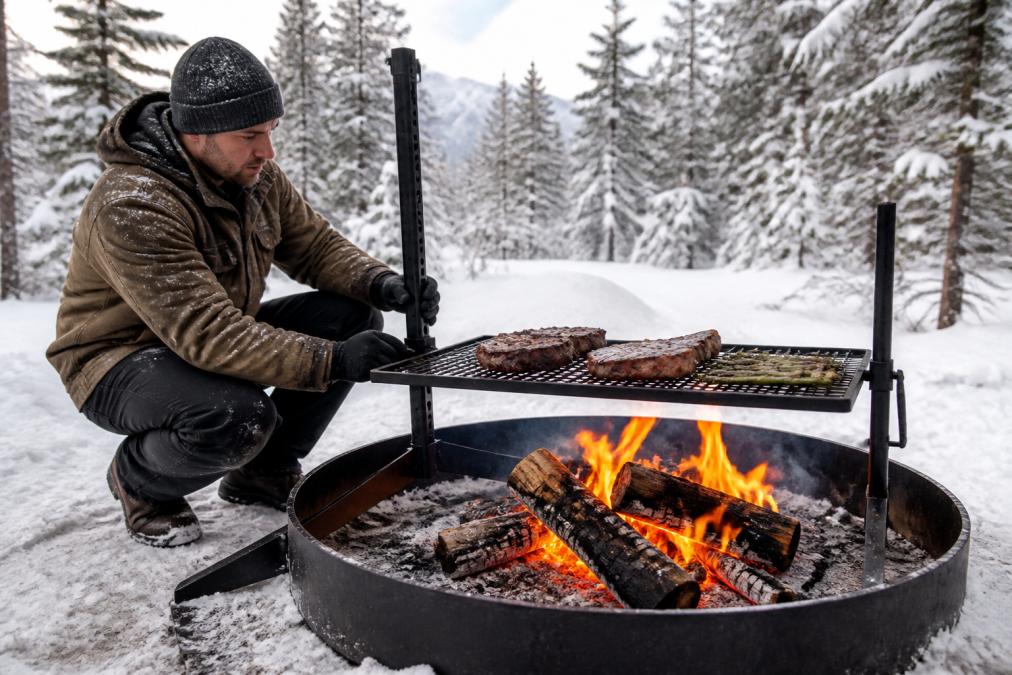
1. The ANVIL Adjustable Campfire Grill: Best Overall for Cold Weather
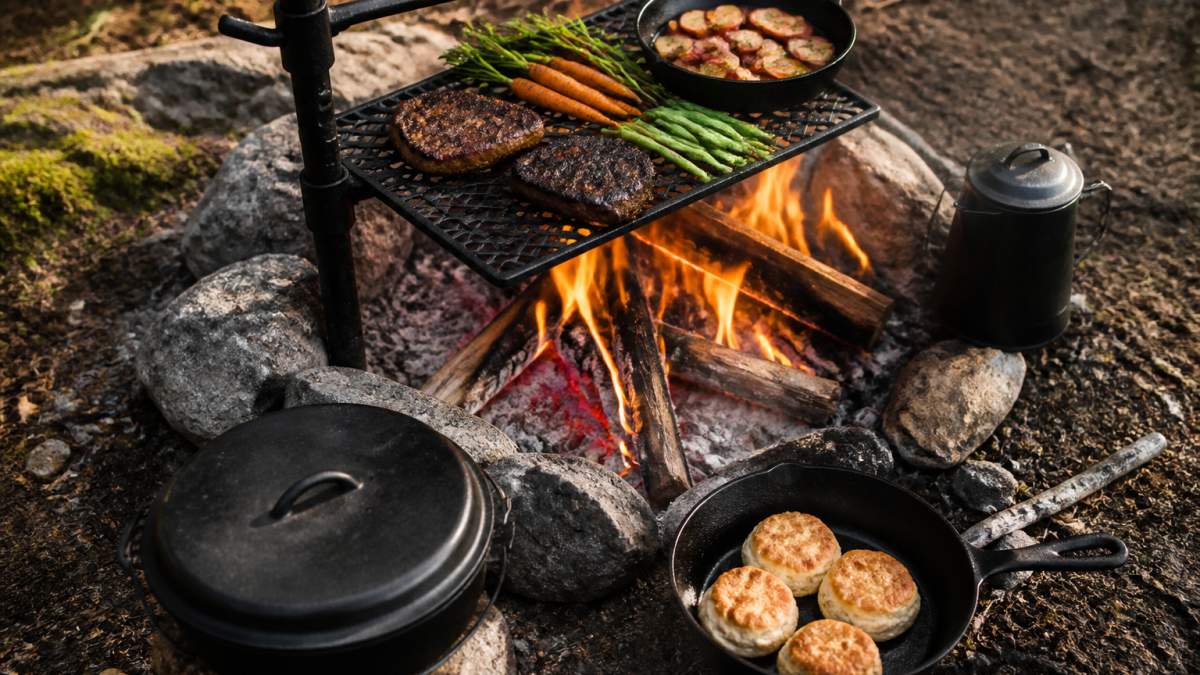
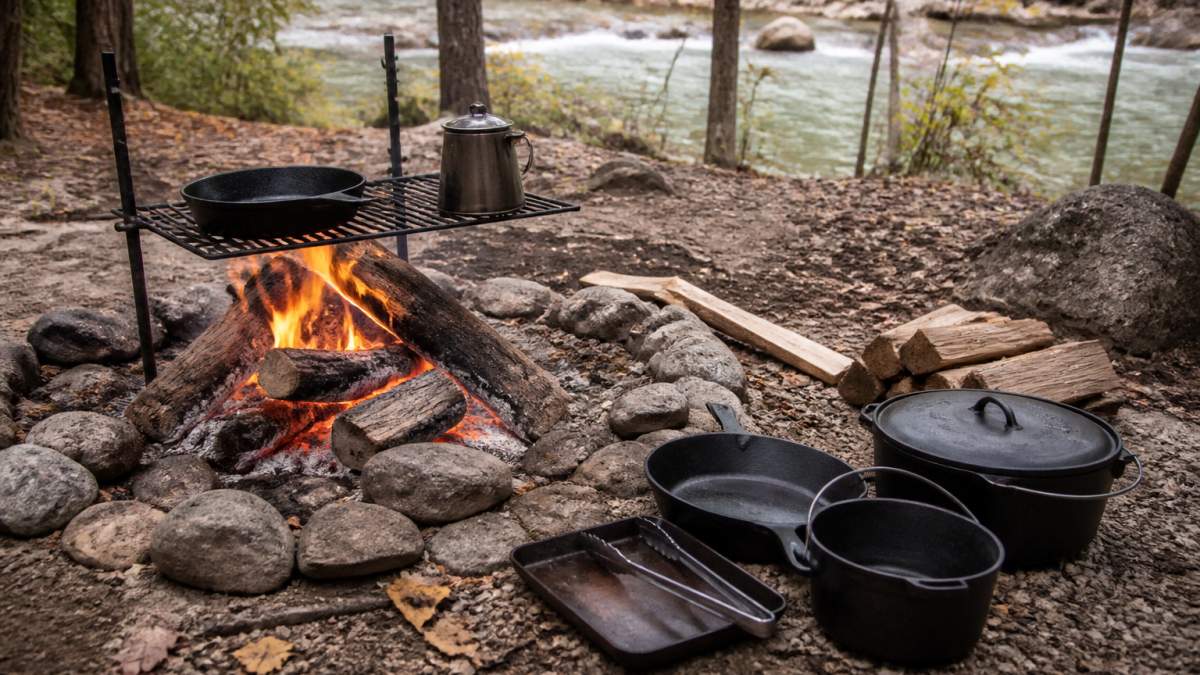
The ANVIL handles everything from a quick sear to a slow braise over an open fire. Its 15 x 20 inch (38 x 50 cm) heavy carbon steel grate holds up to 20 kg (40 lb) without flexing, and the adjustable height lets you dial heat up or down by moving the grate along the stake rather than rebuilding the fire.
2. 12" Dutch Oven: Best for Feeding a Group in Cold Weather
A 12-inch cast iron dutch oven is the workhorse of a cold-weather camp kitchen. The 30.5 cm (12 inch) diameter gives real portions for four to six people, and the thick cast walls spread heat evenly so nothing scorches on one side while the other stays cold.

3. 10" Cauldron with Reversible Lid: Best for One-Pot Winter Meals
The 10-inch cauldron is for nights when one pot has to do everything. Its deep-bellied 25.4 cm (10 inch) cast iron body handles stews, chilis, and camp bread without crowding, and the reversible lid flips flat-side up to become a griddle for biscuits, bacon, or a searing steak.

4. 8" Dutch Oven with Lid: Best for Minimalist Cold-Weather Trips
Not every trip needs the 12-inch. The 8-inch dutch oven is built for the backcountry weekend where every ounce counts but you still refuse to compromise on a proper braise.
5. 7.5" Sauce Pan with Lid: Best for Sauces and Sides
The 7.5-inch sauce pan fills the gap between a skillet and a full dutch oven. At 19 cm (7.5 inch) diameter, it's sized for sauces, sides, oatmeal, and beans, anything that benefits from a steady simmer without a huge pot hogging the fire.
6. Insulated Drinkware: Keeping Drinks Hot in Cold Weather
Hot coffee at dawn that's still hot when you drink it changes a cold morning. Double-wall vacuum insulation makes that possible, whether you're holding a mug by the fire or a tumbler on the trail.
| Drinkware | Capacity | Lid | Best For | Price |
|---|---|---|---|---|
| Insulated Mug | 12 oz (355 mL) | Open-top, gloved-hand handle | Sipping by the fire | $17.99 |
| 16 oz Tumbler | 16 oz (473 mL) | Spill-proof | Commute and trailhead | $19.99 |
| XL Tumbler | 20 oz (591 mL) | Spill-proof | Long days, more volume | $25.99 |
How to Maintain Carbon Steel Cookware in Winter
Carbon steel and cast iron need the same basic care year-round, but winter raises the stakes.
The post-cook routine
- Wash with hot water only. Soap strips the polymerized seasoning layer you've built up. For stuck-on residue, use a stiff brush or chainmail scrubber rather than abrasive pads.
- Dry immediately on heat. Put the piece back over the fire, on coals, or on a warm stovetop until every trace of water is gone. Air-drying in cold, damp conditions is how rust starts, and a cold piece dries far more slowly than a warm one.
- Re-oil after every use. A thin coat of a neutral high-smoke-point oil (canola, grapeseed, or flax) while the metal is still warm keeps seasoning glossy and non-stick. Wipe off the excess; a thick coat turns gummy and traps moisture underneath.
- Never the dishwasher. One cycle strips seasoning that took months to build, and the heated dry cycle leaves the bare metal wet.
- Store dry and oiled. For cold storage, give the piece a light oil coat first and leave a paper towel between stacked pieces to wick condensation.
Winter-specific winterization
Cold weather adds two problems the summer routine ignores: condensation and thermal shock.
The ANVIL grill specifically
A quick summary of the full lineup and where each piece fits:
| Piece | Best For | Key Feature | Price |
|---|---|---|---|
| ANVIL Adjustable Campfire Grill | Best overall | Adjustable height, 40 lb capacity | $174.99 |
| 12" Dutch Oven | Feeding a group | Flanged lid for camp-oven baking | $52.99 |
| 10" Cauldron | One-pot meals | Reversible lid doubles as griddle | $45.99 |
| 8" Dutch Oven | Minimalist trips | Lightweight, serves 1-2 | $45.99 |
| 7.5" Sauce Pan | Sauces and sides | Fitted lid for steady simmer | $37.99 |
| Insulated Drinkware | Hot drinks in the cold | Double-wall vacuum insulation | $17.99 and up |
Frequently Asked Questions
What materials are best for outdoor cooking equipment in freezing temperatures?
Cast iron and heavy carbon steel are the best materials for freezing temperatures because they retain heat exceptionally well and resist thermal shock. Cast iron, like the Browns Outpost 12-inch Dutch Oven, holds steady heat for slow cooking, while carbon steel, like the ANVIL Grill, heats quickly and adjusts to temperature changes. Both handle direct flame and coal contact without warping. Stainless steel is durable but conducts heat less evenly.
How do you maintain cast iron cookware during winter months?
Maintain cast iron in winter by drying it immediately after washing with hot water, then re-oiling it with a thin coat of neutral oil to prevent rust. Never use soap or a dishwasher, as both strip the seasoning. If you cook over a fire, burn off residue and brush the surface clean while warm. Store the cookware in a dry place. Re-season after every few uses to keep the non-stick surface intact.
Is carbon steel better than stainless steel for cold-weather outdoor cooking?
Carbon steel is better for cold-weather cooking because it heats faster and more evenly than stainless steel, and it holds heat well over an open fire. The ANVIL Grill uses heavy carbon steel, which is acid-bathed and pre-seasoned with olive oil, giving it a chemical-free cooking surface. Stainless steel resists rust but conducts heat poorly. Carbon steel requires more maintenance, like oiling after each use, but its performance in freezing temperatures makes it the preferred choice for durable outdoor cooking equipment.
How does cold weather affect the efficiency of outdoor cooking equipment?
Cold weather reduces fuel efficiency because heat escapes faster into the surrounding air, so you need more fuel or a hotter fire to maintain cooking temperatures. Insulated cookware, like cast iron Dutch ovens, helps retain heat and reduces fuel use. Wind protection is also critical; a heavy-duty campfire grill with an adjustable grate lets you lower the cooking surface closer to the coals to compensate for heat loss. Using a lid and preheating your cookware can cut fuel consumption significantly in sub-zero conditions.
What are the safety considerations for cooking over an open fire in the snow?
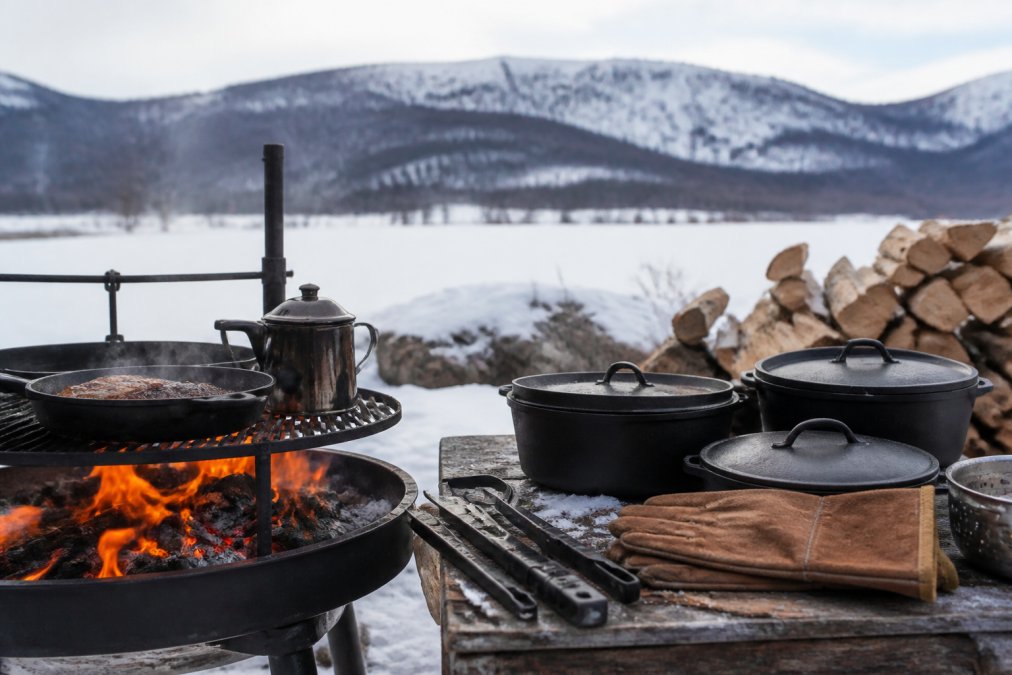
When cooking over an open fire in the snow, build your fire on a stable, cleared surface to prevent it from sinking or spreading. Keep a safe distance from overhanging branches and never leave the fire unattended. Use heavy-duty tools like cast iron cookware and a sturdy adjustable grill to avoid tipping. Wear heat-resistant gloves and avoid loose clothing. Always extinguish coals completely with water and stir the ashes.