 listicle
Lightweight Campfire Grill for Backpacking Trips: 2026 Guide
Table of Contents
- What Makes a Campfire Grill Trail-Ready
- How to Cook Over a Campfire While Backpacking
- Ultralight Backpacking Cooking Gear: What to Carry
- Campfire Cooking Safety Tips for Backcountry Trips
- Stability, Setup Time, and Clean-Up in the Field
- Multi-Fuel Versatility: Wood, Charcoal, and DIY Options
- The ANVIL Grill: A Durable Campfire Grill for Backpacking
- Frequently Asked Questions
Last Updated: September 15, 2026
What Makes a Campfire Grill Trail-Ready
A trail-ready campfire grill is a portable cooking grate built to survive open fire, pack down small, and hold up under real backcountry use. At Browns Outpost, we've watched enough gear fail at camp to know the difference between a grill that looks good in a product photo and one that earns its place in your pack.
Weight, packed size, and material quality decide everything. A grill that's too heavy gets left behind, and thin, plated steel warps over hot coals. Carbon steel and titanium resist heat deformation and corrosion far longer.
The trade-off is real, though. Titanium is lighter but costs more and conducts heat unevenly. Carbon steel is heavier but spreads heat predictably and lasts for years with basic care.
Weight, Packed Size, and Material Trade-offs
Backpackers typically carry a base weight between 4.5 and 9 kg (10 to 20 lb), so every piece of gear competes for space (REI's guide to backpacking weight). A grill that folds flat and weighs under 1 kg is the sweet spot.
| Material | Weight | Heat Distribution | Durability | Best For |
|---|---|---|---|---|
| Titanium | Lightest | Uneven | High | Ultralight solo trips |
| Carbon steel | Moderate | Even | Very high | Group cooking, durability |
| Stainless steel | Heavier | Moderate | High | General camping |
| Aluminum | Light | Poor at high heat | Low | Cold meals only |
Stainless steel resists corrosion but adds weight; aluminum deforms under direct heat, making it a poor choice for wood or charcoal cooking.
How to Cook Over a Campfire While Backpacking
Cooking over a campfire while backpacking comes down to four things: building a proper coal bed, controlling distance from the heat, managing your cooking surface, and knowing how much fuel a meal costs. Skip any one and you'll burn dinner or burn through wood you had to carry.
Start with a fire pit ring or cleared bare ground. Build a small fire and let it burn down to coals, roughly 20 to 30 minutes. Flames cook unevenly, while coals give steady, direct heat (USDA Forest Service guide to campfire safety). Hardwoods like maple, oak, or birch produce denser coals than softwoods such as pine or spruce, which flare up and collapse fast. Gather dead-and-down wood around the thickness of your wrist; it burns down to usable coals faster than thick logs.
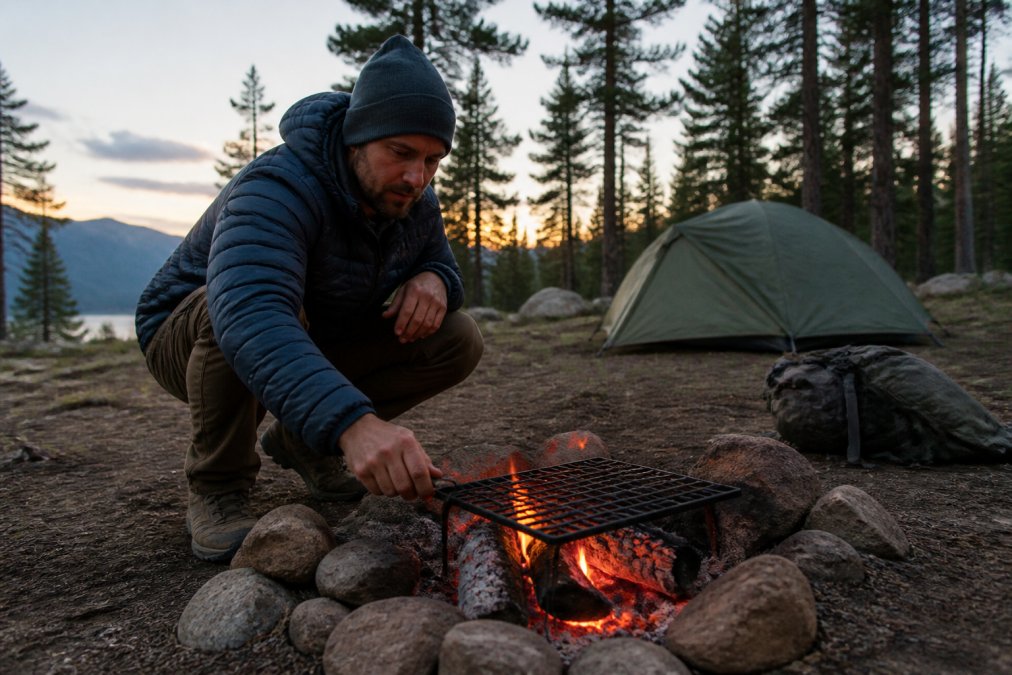
Reading the Coal Bed: Heat Zones and Grate Height
Once your fire has burned down, rake the coals into zones rather than a single flat bed: a hot zone (3 to 4 cm of glowing coals) for searing, a medium zone (2 cm) for cooking through, and a cool zone (a thin scatter) for resting food. This lets you move food instead of rebuilding the fire.
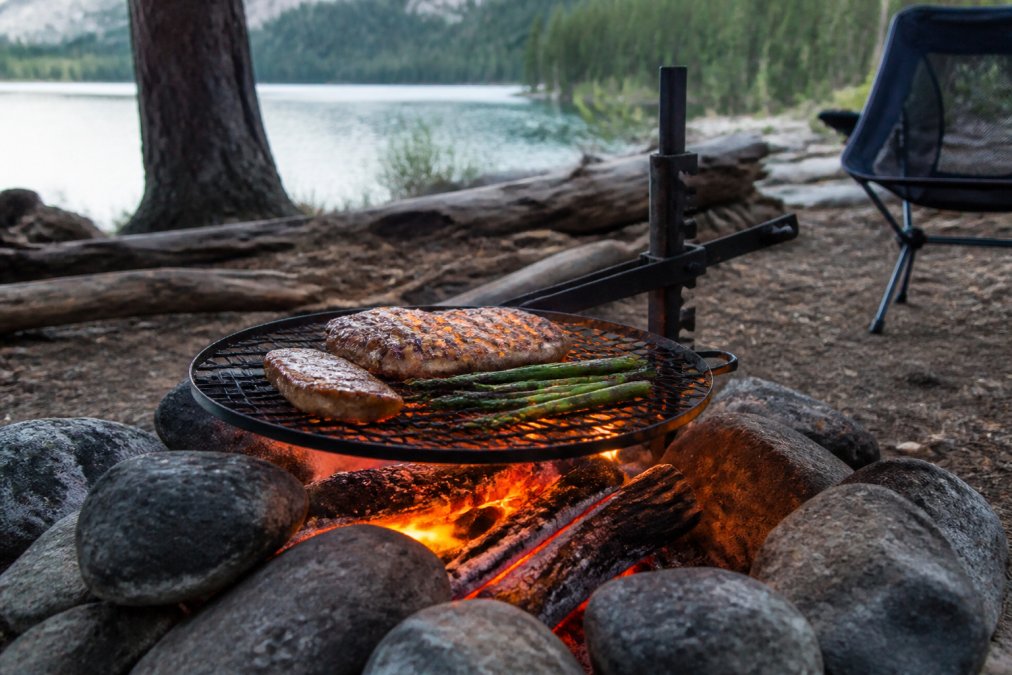
Place your grate 10 to 15 cm above the coals: too close and food scorches, too far and you're just warming it. Adjustable-height grills solve this without rebuilding the fire. As a rule of thumb, you can hold your palm at grate height for about 4 to 5 seconds over a medium coal bed; much shorter means searing territory, much longer means you need more coals or a lower grate.
The Weight-to-Calorie Case for Grilling vs. Cold Soaking
Here's the angle most gear guides skip: a grill has to earn its pack weight in calories, not just convenience. A typical backpacking dinner of dehydrated beans and rice delivers roughly 600 to 700 calories and weighs about 150 g dry. Cold-soaking saves the fuel and the grill, but you eat cold, rehydrated food, which many hikers under-eat on long days.
Grilled food changes the math in two ways. Fresh proteins and vegetables cooked over fire carry more water and volume per calorie than dehydrated meals, so you feel fuller on the same calorie count. And a hot meal at camp reliably increases how much people eat, which matters when you're burning 3,000 to 5,000 calories a day (Study on calorie expenditure and intake in hiking). A sub-1 kg grill that turns three cold dinners into three hot ones often beats an extra day of snacks.
Run the numbers for your own trip: divide your grill's weight by the number of hot meals you'll cook. A 700 g grill used for six dinners works out to about 117 g per meal, comparable to a fuel canister, and it doesn't run out.
Managing Direct Heat and Charcoal
Charcoal briquettes give more predictable heat than wood, but they're heavy: a standard briquette weighs roughly 20 to 25 g, so a two-night trip using six per meal adds around 300 to 400 g before you've cooked anything. Most backpackers use wood and manage heat by moving coals with a stick or small shovel.
A common mistake is crowding the grate. Leave gaps between food so heat circulates and moisture escapes, and give food-grade carbon steel a minute to settle before cooking. For more than two people, cook in batches; a crowded grate steams food instead of grilling it.
Ultralight Backpacking Cooking Gear: What to Carry
Ultralight backpacking cooking gear should cover three jobs: boiling water, cooking over direct heat, and cleanup. Everything else is optional.
A practical kit for a two-night trip:
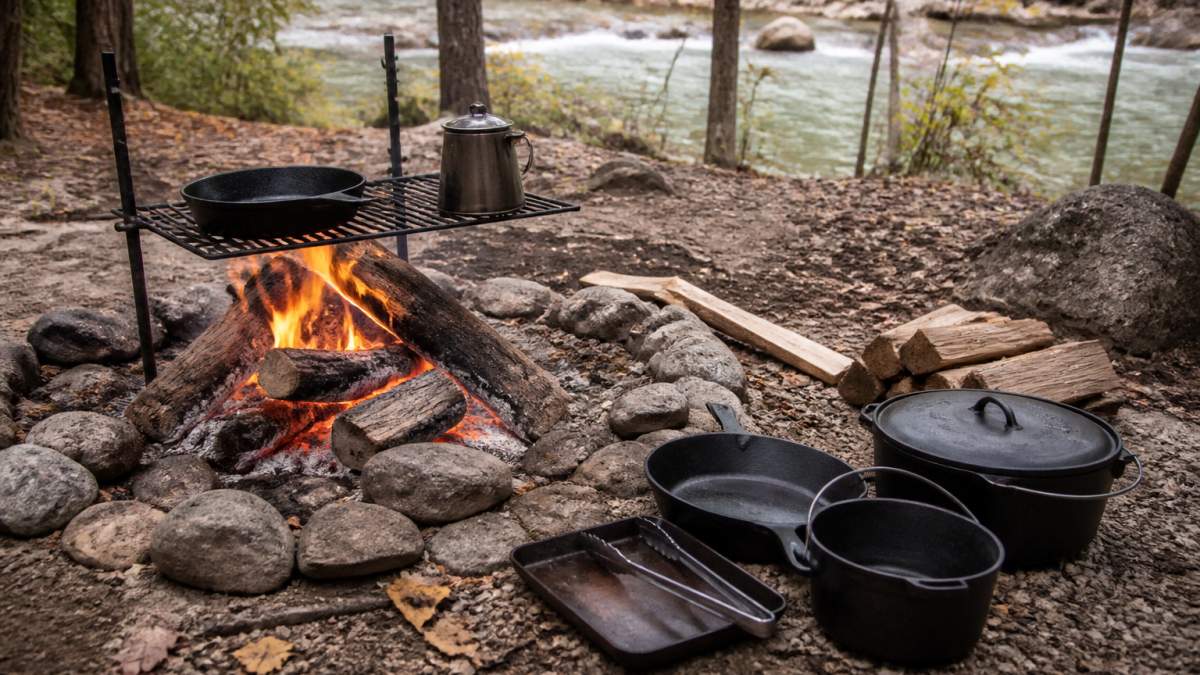
- A folding grill grate (under 1 kg)
- A small cast iron Dutch oven or lightweight pot
- A compact fire-starting kit
- A multi-tool with pliers
- A small scraper or chainmail scrubber
- A cloth for wiping down the cooking surface
The 8" Dutch Oven with Lid from Browns Outpost weighs little enough for minimalist trips but still handles a braise or stew over coals. Cast iron holds heat longer than thin cookware, so you use less fuel.

Campfire Cooking Safety Tips for Backcountry Trips
Campfire cooking safety tips start with fire control. Check local fire bans before you leave, and never build a fire during a restriction. In Canada, provincial and territorial authorities publish fire bans that change with conditions, so verify before every trip.
Other essentials:
- Clear a 1-metre radius around your fire pit of leaves, twigs, and roots
- Never leave a fire unattended, even for a few minutes
- Keep water or dirt within arm's reach to extinguish
- Let coals cool completely before you leave, then scatter ash
- Store food in a bear hang or canister well away from your sleep area
Stability, Setup Time, and Clean-Up in the Field
Stability on uneven terrain separates a grill you'll use from one you'll curse.
Multi-Fuel Versatility: Wood, Charcoal, and DIY Options
Wood, Charcoal, and Stove Fuel Compared
DIY vs. Commercial: When a Hardware Store Grate Is Enough
Leave No Trace: Using a Grill Without Leaving a Scar
The ANVIL Grill: A Durable Campfire Grill for Backpacking
Frequently Asked Questions
What is the lightest campfire grill for backpacking?
Titanium grills are the lightest option, often under 200 grams, but they can warp under high heat and are expensive. Carbon steel grills weigh more but last longer and hold heat better. The ANVIL Grill uses heavy carbon steel for durability, so it suits backpackers who prioritize a reliable cooking surface over saving every ounce. For solo trips, a simple folding grate may be enough; for group cooking, a sturdier campfire grill pays off.
Is a campfire grill necessary for backpacking?
Not always. If you rely on a canister stove, you can skip a grill. But for cooking over wood or charcoal, a campfire grill gives you a stable cooking surface, better heat distribution, and keeps food off direct flames. Many parks and backcountry areas require a grate or fire ring. A lightweight grill also lets you cook real meals instead of just boiling water, which matters on longer trips.
How do you clean a portable campfire grill in the backcountry?
Wait for the grill to cool, then scrub it with a small wire brush or a ball of aluminum foil. Avoid soap near water sources. For carbon steel, wipe it dry and rub on a thin layer of oil to prevent rust. If you are packing out, use a carry bag to keep soot off your gear. A clean grill is easier to maintain and lasts longer.
What materials are best for a lightweight backpacking grill?
Titanium is the lightest and resists corrosion, but it can bend under heavy loads. Stainless steel is durable and food-grade, though heavier. Carbon steel offers excellent heat distribution and holds up to repeated use, but needs oiling to prevent rust. For backpacking, pick based on how much weight you will trade for durability. The ANVIL Grill uses carbon steel for a balance of strength and cooking performance.
Packing light and cooking well over a fire don't have to be opposites. The challenge is finding gear that survives real backcountry conditions without weighing you down. Browns Outpost builds the ANVIL Grill from hand-crafted raw carbon steel with adjustable height, a 20 kg weight limit, and a lifetime warranty, so you get pro results over any fire without replacing your setup every season. Get started with Browns Outpost and cook your next backcountry meal on gear built to last.