 how-to
How to Choose Cast Iron for Open Fire Cooking
Table of Contents
- What You Need to Know Before You Buy Cast Iron for Open Fire Cooking
- Why Cast Iron Works Over Live Fire
- Material Thickness, Thermal Mass, and Heat Retention Explained
- Bail Handle vs. Long Handle: Choosing the Right Grip for Fire Cooking
- Surface Finish Comparison: Pre-Seasoned, Raw, and Enameled Cast Iron
- How to Reseason Cast Iron Pans Step by Step
- How to Clean Cast Iron After Campfire Cooking
- Benefits of Carbon Steel vs Cast Iron for Camping
- Best Cast Iron Pieces for Different Fire Structures
- Frequently Asked Questions
Last Updated: September 10, 2026
What You Need to Know Before You Buy Cast Iron for Open Fire Cooking
Choosing the wrong pan for live fire ruins meals and wastes money. Learning how to choose cast iron for open fire cooking comes down to three variables: wall thickness, handle design, and surface finish.
At Browns Outpost, we build camp cookware for coals and open flame. Most buyers go wrong by buying a lightweight kitchen pan, then wonder why it warps over embers.
Here's the short version before we go deeper:
- Thick walls hold heat and resist warping. Thin walls heat fast and cool fast.
- A bail handle suits hanging and lid work. A long handle suits direct grate cooking.
- Raw or pre-seasoned iron handles fire. Enamel does not.
The decisions below cover thermal mass to rust prevention, plus the mistakes that cost people a season of cooking.

Why Cast Iron Works Over Live Fire
Cast iron works over a fire because its high thermal mass absorbs heat slowly and releases it steadily, evening out the hot spots and flare-ups that ruin food on an open flame. That's why a dutch oven can hold a simmer for an hour on nothing but coals.
Cast iron is an iron-carbon alloy with high carbon content, so it stores and radiates heat rather than conducting it away instantly. Carbon steel behaves similarly, but cast iron's thicker cross-section gives it more thermal mass for the same footprint.
That matters most when heat is uneven. A campfire has hot zones, cold zones, and flames that surge when fat drips. A heavy pan buffers all of it.
Material Thickness, Thermal Mass, and Heat Retention Explained
Wall thickness determines how much heat a pan stores and how evenly it releases it. A thicker pan takes longer to heat but holds temperature through cold wind, drizzle, or a pause while you plate.
Thin cast iron heats and cools fast, which suits a quick sear but means constant babysitting on a fluctuating fire.
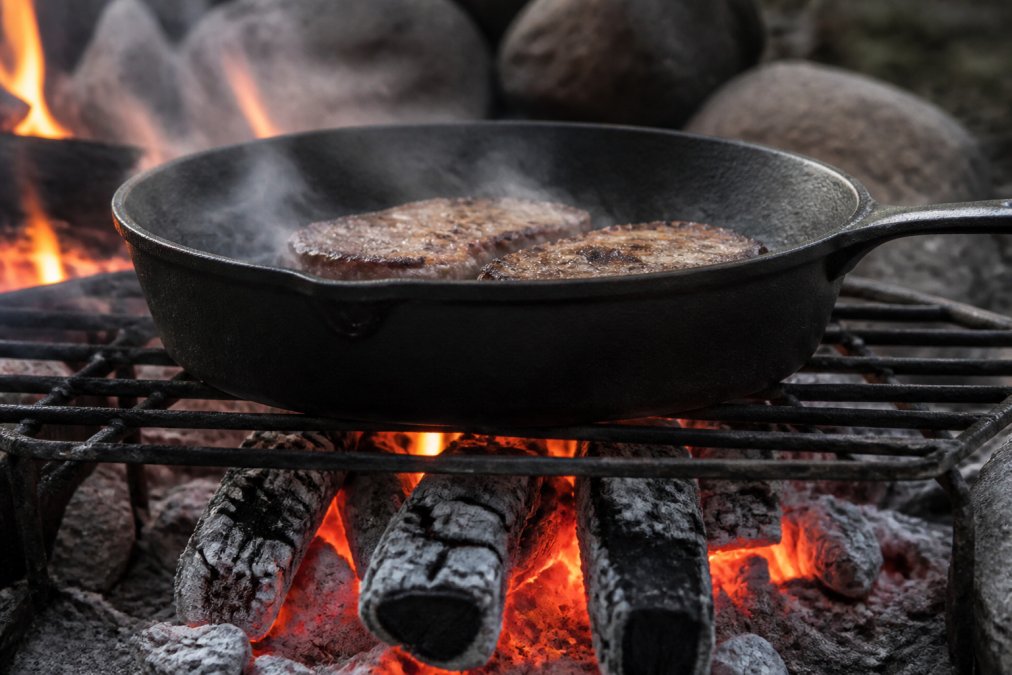
Why Thicker Walls Hold Heat Longer
Thicker walls hold heat longer because there is more metal to store it. When you add cold food, stored heat keeps the surface from crashing, producing a proper sear instead of a steamed grey finish.
A common mistake is buying the lightest pan available for backpacking, then discovering it cannot hold temperature when you add a pound of meat. Weight is not a flaw in cast iron. It is the feature.
Heat Distribution: Direct vs. Indirect Fire Setups
Heat distribution depends on how you sit the pan relative to the coals. Direct heat gives a hot, fast zone; indirect heat, with the pan off to the side or elevated, gives gentle, even cooking for longer times.
For a dutch oven, the classic setup is coals underneath and coals on the lid, which turns the whole vessel into an oven. For a skillet, direct heat over a low coal bed beats a tall flame every time.
Bail Handle vs. Long Handle: Choosing the Right Grip for Fire Cooking
Handle design is the second-biggest decision after wall thickness, because it determines what you can do with the pan over a fire. A bail handle suits hanging, lid lifting, and dutch oven work; a long handle suits direct grate cooking where you move the pan without a hook or glove. Which one you buy depends on your fire structure.
The bail handle, a curved metal loop that swings over the top, lets you hang a pot from a tripod or grill arm and adjust height for temperature control. Raising the pot 10 centimetres above the coals can stop a boil; lowering it back brings it right back (National Park Service guidance on campfire cooking tools(https://www.nps.gov/fosc/learn/education/cooktools.htm)). A bail also stays cooler when the pan sits low in the coals, because the loop sits above the heat rather than beside it.
The trade-off with a bail is that you need a hook, a tripod, or a grill arm to use it well. Without one, you are stuck lifting a hot loop with a gloved hand, which is awkward on a heavy dutch oven.
A long handle gives reach and use over a hot grate. The longer the handle relative to the pan's weight, the more control you have when tilting to pour off fat or sliding food to a cooler zone. The trade-off: it's harder to hang and takes more pack space. On a skillet above roughly 25 centimetres, a short handle becomes a lever arm that can torque your wrist when loaded.
Dual-handle pieces, usually a short loop on each side, suit griddles and other wide, heavy cookware. They give a two-handed lift for a loaded pan but offer less reach over a fire, so you need a grate or stable coal bed rather than a hanging setup.
| Handle Type | Best For | Main Trade-Off |
|---|---|---|
| Bail handle | Hanging, dutch ovens, lid work, height adjustment | Needs a hook or tripod |
| Long handle | Grate cooking, quick moves, tilting to pour | Bulky to pack, lever arm on heavy pans |
| Dual handle | Griddles, heavy loads, two-handed lifts | Less reach over fire |
A detail most guides skip: the handle's connection matters as much as its shape. Riveted or welded handles transfer less heat to your hand than handles cast as one piece, because the joint breaks the thermal path. On a long-handle skillet, a leather or heavy canvas sleeve over the last third of the handle is standard practice for grate work.
Surface Finish Comparison: Pre-Seasoned, Raw, and Enameled Cast Iron
Pre-seasoned iron is the easiest starting point, raw iron gives you control, and enameled iron is wrong for open fire. Seasoning, polymerized oil bonded to the iron, creates the non-stick surface and blocks rust.
Pre-seasoned cookware arrives ready to use with a factory-applied oil layer. It saves time, but you still build your own patina over repeated cooks.
Raw iron, like the hand-crafted raw carbon steel Browns Outpost uses, lets you control seasoning from the first coat. More upfront work, but a surface you understand completely.

Enameled iron has a glass coating that chips under high heat and thermal shock. It belongs on a stovetop, not in a fire pit.
How to Reseason Cast Iron Pans Step by Step
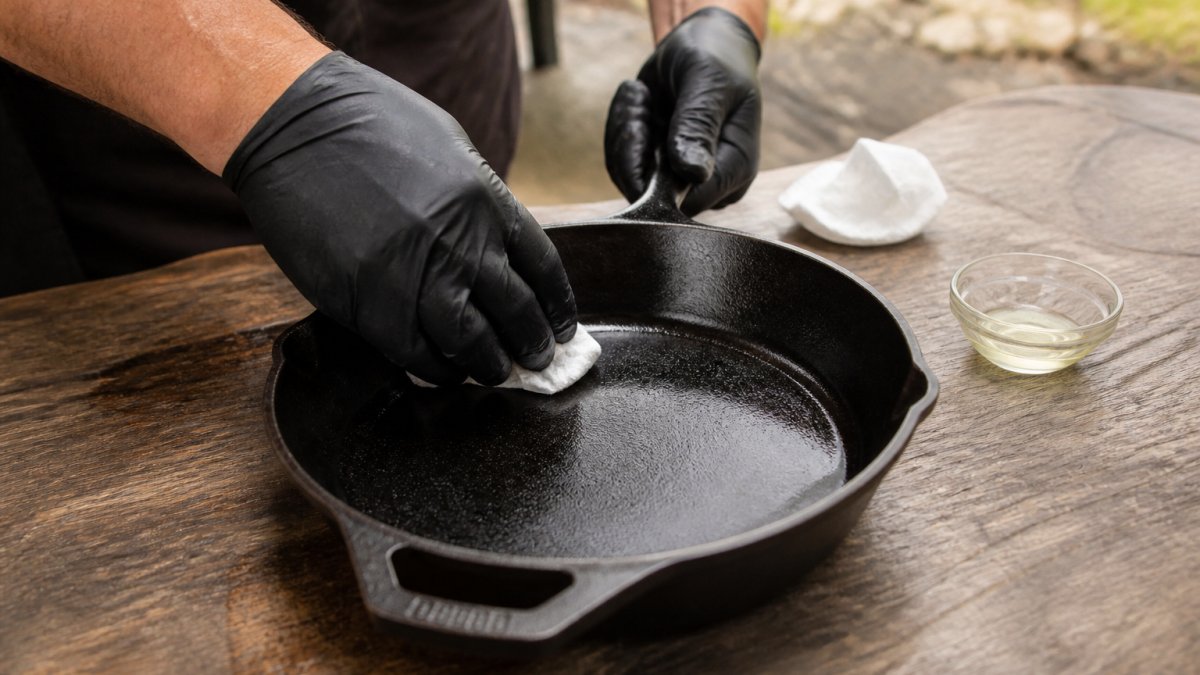
Reseasoning restores the protective oil layer after rust, scouring, or a stripped surface. It takes about an hour of oven time and rebuilds the non-stick surface from scratch.
- Scrub the pan with hot water and steel wool to remove rust and old flaking seasoning.
- Dry it completely on a stovetop over low heat so no moisture remains.
- Apply a thin coat of high smoke point oil, such as flaxseed or grapeseed, across the whole surface.
- Wipe off the excess until the pan looks almost dry. Too much oil leaves a sticky finish.
- Place it upside down in an oven at roughly 230°C (450°F) for one hour.
- Turn the oven off and let the pan cool inside.
- Repeat the oil and bake cycle two or three times for a durable layer.
How to Clean Cast Iron After Campfire Cooking
Cleaning cast iron after campfire cooking means scraping off food while the pan is still warm, rinsing with hot water, and drying it over heat immediately. Skip the soap, skip the soak, and never let it air dry.
A stiff scraper or chainmail scrubber handles most residue; for stubborn spots, coarse salt and a splash of water work as an abrasive. Once clean, put the pan back over the coals or a burner until every trace of moisture evaporates.
Then wipe a thin film of oil across the surface while it is still warm. That film is your rust prevention for the trip home.
For a deeper reference on care and storage, the National Park Service guidance on campfire safety and cooking is worth a read before your next trip.
Benefits of Carbon Steel vs Cast Iron for Camping
Carbon steel is lighter and responds to heat changes faster; cast iron holds heat longer and resists warping better. For backpacking, carbon steel wins on weight. For car camping and base camps, cast iron wins on performance.
Both are iron-carbon alloys and both need seasoning. The difference is thickness. Carbon steel pans are rolled thinner, so a 25-centimetre carbon steel skillet weighs noticeably less than the same size in cast iron.
That weight matters when every kilogram is on your back. It matters far less when the vehicle is parked beside the site.
| Factor | Cast Iron | Carbon Steel |
|---|---|---|
| Weight | Heavier | Lighter |
| Heat retention | High | Moderate |
| Heat response | Slow | Fast |
| Best for | Car camping, base camp | Backpacking, quick meals |
If you want one pan that does both jobs without compromise, a piece like the 10" Shallow Skillet covers breakfast and dinner over coals.
Best Cast Iron Pieces for Different Fire Structures
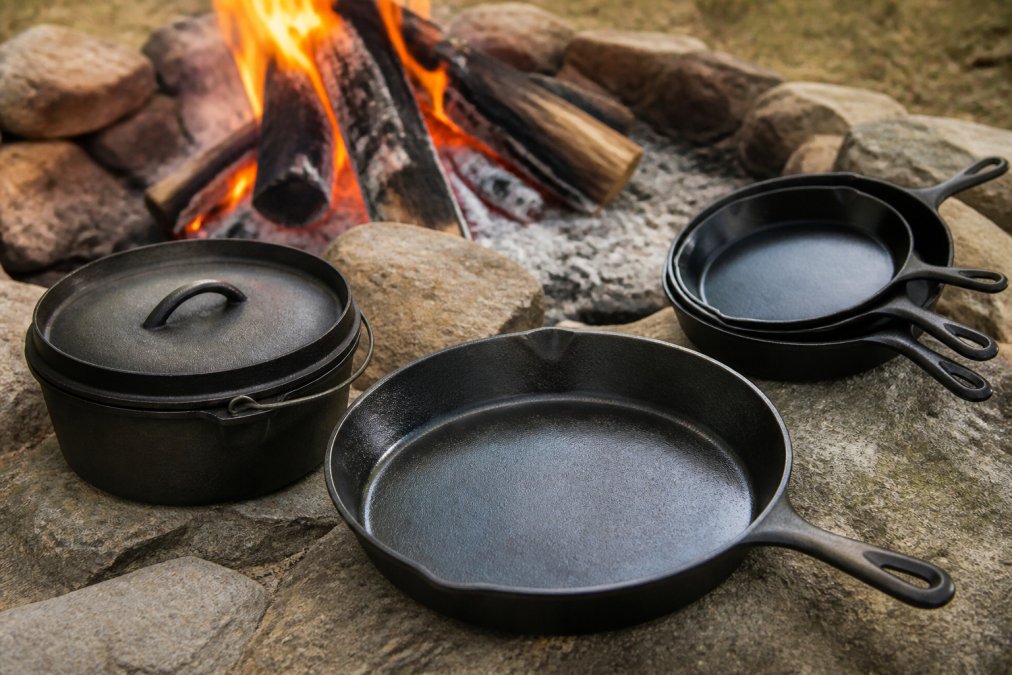
The right piece depends on your fire setup. A grate, tripod, coal bed, and dutch oven stand each call for different cookware, and matching the two separates a smooth cook from a frustrating one. Each structure delivers heat differently, so the pan has to match the heat delivery.
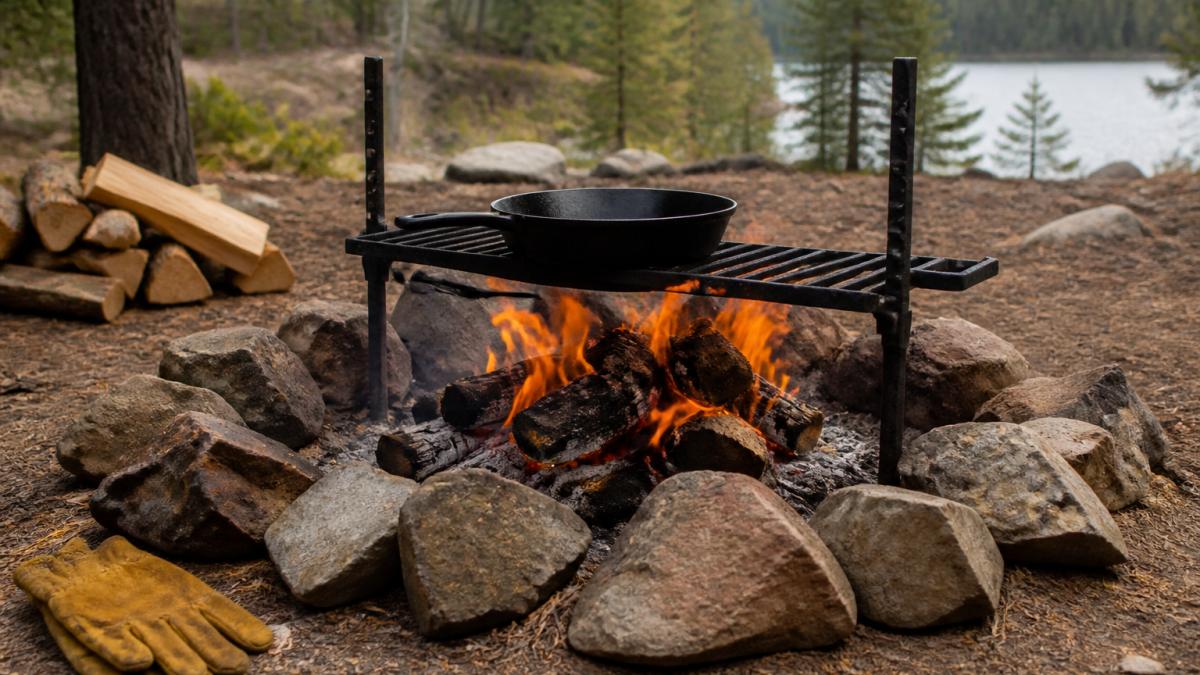
Grate over coals: a shallow skillet or a 16"×9" Griddle gives flat surface area for pancakes, eggs, and bacon at once. A grate lifts the pan a fixed distance above the coals, so you control temperature by moving coals under the grate rather than moving the pan. A wide, flat piece makes that easier, slide food from the hot centre to the cooler edges without lifting anything.
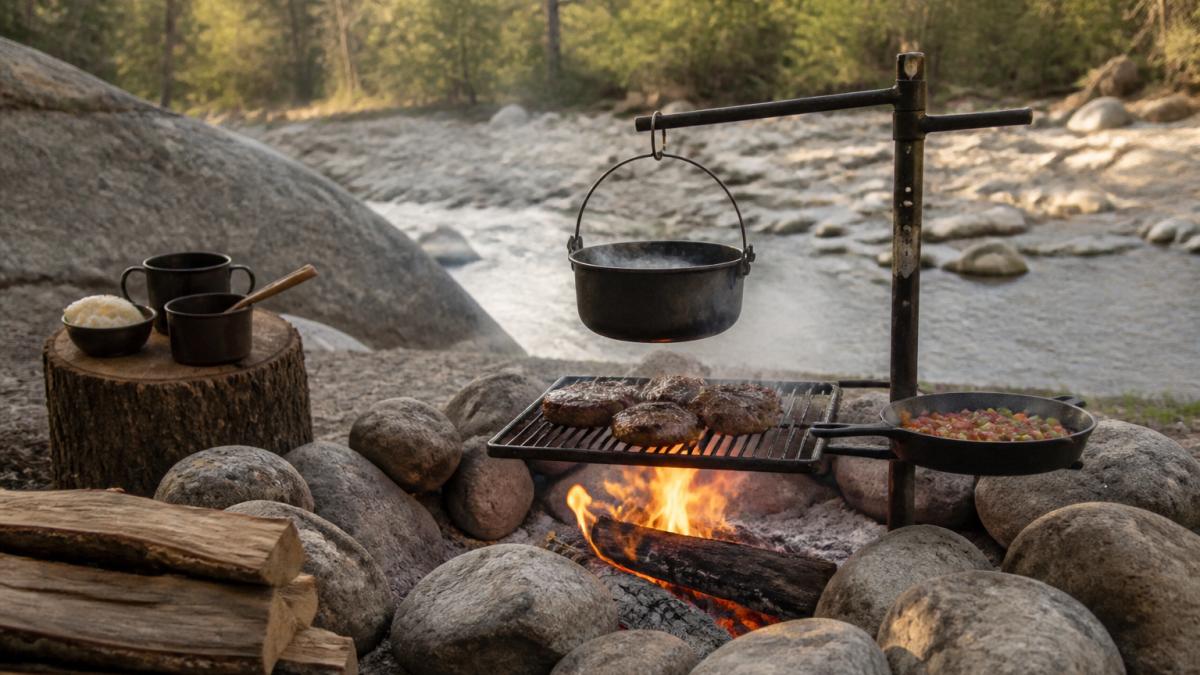
Tripod or grill arm: a 12" Dutch Oven hangs or sits on coals for braises, stews, and bread. The tripod's advantage is adjustable height: raise the pot to stop a boil or lower it to build one, which a fixed grate cannot do. A bail handle is mandatory, and a rimmed lid holds coals on top for the oven effect.
Deep coal bed: a 10" Cauldron with Reversible Lid handles one-pot meals, and the lid doubles as a griddle. Direct burial in coals is the hottest, least even setup, so a thick-walled vessel with a tight lid is the only way to keep a stew from scorching on the bottom while the top stays cool.

Dutch oven stand or raised ring: the setup for baking and long simmers. The stand holds the oven above the coal bed so heat comes from below and from a measured ring of coals on the lid. A ring of coals on the lid plus a matching ring underneath holds a steady bake temperature for close to an hour without adding fuel, the standard camp oven method.
The Weight-to-Utility Trade-Off Most Guides Ignore
Every guide assumes you are car camping. If you are hiking in, the calculus changes, and cast iron usually loses to carbon steel.
A cast iron skillet in the 25-centimetre range typically weighs several kilograms; a comparable carbon steel skillet weighs a fraction of that. On a flat walk from the vehicle, that's irrelevant. On a multi-kilometre approach with elevation gain, it's the difference between a comfortable pack and a miserable one.
The practical rule experienced fire cooks follow: carry cast iron when the fire is the destination, carbon steel when the fire is a stop along the way. Base-camping, hiking in with a group, or cooking for several people? Cast iron's thermal mass earns its weight. Solo, moving daily, or counting grams? A thinner carbon steel pan plus a small dutch oven is the better kit.
A middle path many miss: carry one heavy piece and one light piece. A cast iron dutch oven for low, slow cooking that needs thermal mass, plus a thin carbon steel skillet for quick sears and eggs. That pairing covers almost every campfire meal without two heavy pans.
Frequently Asked Questions
Can cast iron be used on open fire?
Yes. Cast iron is one of the few cookware materials that handles direct flames and hot coals without warping or breaking down. The key is to avoid sudden temperature changes, which can crack the metal. Let the pan heat gradually over coals rather than plunging it into a roaring fire. A well-seasoned cast iron skillet or dutch oven develops a natural non-stick surface that improves the more you use it over live fire.
What size cast iron skillet is best for camping?
A 10-inch shallow skillet is the most versatile size for campfire cooking. It is large enough to cook breakfast for two or sear a steak, but light enough to pack without adding too much weight. If you are cooking for a group, a 12-inch dutch oven or a 16x9-inch griddle gives you more surface area for batch cooking. Match the size to your group and your transport method.
Is raw carbon steel a better alternative to cast iron for open fires?
It depends on your priority. Carbon steel heats faster and weighs less, which matters for backpacking. Cast iron holds heat longer and distributes it more evenly, which matters for slow cooking and baking. Both develop a seasoned patina over time. For car camping and group cooking, cast iron's thermal mass is hard to beat. For solo trips where every gram counts, carbon steel has the edge.
How do you prevent cast iron from rusting when camping in wet conditions?
Dry the pan thoroughly after every wash, then apply a thin layer of cooking oil while it is still warm. Store it wrapped in a cloth or paper towel to absorb moisture. If rust does appear, scrub it off with steel wool, wash, dry, and reseason. A well-maintained patina acts as a barrier against oxidation, so the more consistently you season, the less rust becomes an issue in the field.