 how-to
How to Build a Safe Campfire for Cooking
Table of Contents
- Choosing a Safe Location for Your Cooking Fire
- Building the Fire: Tinder, Kindling, and the Best Wood for Campfire Cooking
- Fire Structures for Cooking: Teepee, Log Cabin, and the Trench
- Essential Campfire Cooking Gear for Safe Open-Fire Meals
- Managing Heat: How to Cook Over a Safe Campfire
- How to Extinguish a Campfire Safely and Leave No Trace
- Provincial Fire Ban Regulations and Campfire Safety Rules
- Common Mistakes to Avoid When Building a Cooking Fire
- Frequently Asked Questions
Last Updated: September 30, 2026
Choosing a Safe Location for Your Cooking Fire
The first rule of how to build a safe campfire for cooking: pick the right spot before you touch a stick. A safe campfire starts with bare ground, clear overhead space, and a plan for where sparks land.
Remove these items from your fire zone:
- Dry grass, leaves, and pine needles
- Twigs and low brush
- Overhanging branches (check at least 3 metres up)
- Roots and buried combustibles near the surface
- Tents, gear bags, and fuel canisters
Building the Fire: Tinder, Kindling, and the Best Wood for Campfire Cooking
The best wood for campfire cooking is dry hardwood like oak, maple, or birch: it burns hot, lasts long, and produces steady coals. Softwoods like pine and spruce light fast but burn out quickly and leave little coal bed.
You need three layers to build a fire that cooks well:
- Tinder: dry grass, birch bark, wood shavings, or commercial fire starters
- Kindling: pencil-thick dry twigs, split small
- Fuel wood: split logs, roughly wrist-thick to forearm-thick
Fire Structures for Cooking: Teepee, Log Cabin, and the Trench
Three fire structures work best for cooking, each producing a different kind of heat.
| Structure | Best For | Heat Style | Setup Time |
|---|---|---|---|
| Teepee | Boiling, searing | High, fast | 5 minutes |
| Log cabin | Dutch oven, slow cooking | Steady, wide | 10 minutes |
| Trench | Windy sites, grilling | Concentrated, even | 15 minutes |
Essential Campfire Cooking Gear for Safe Open-Fire Meals
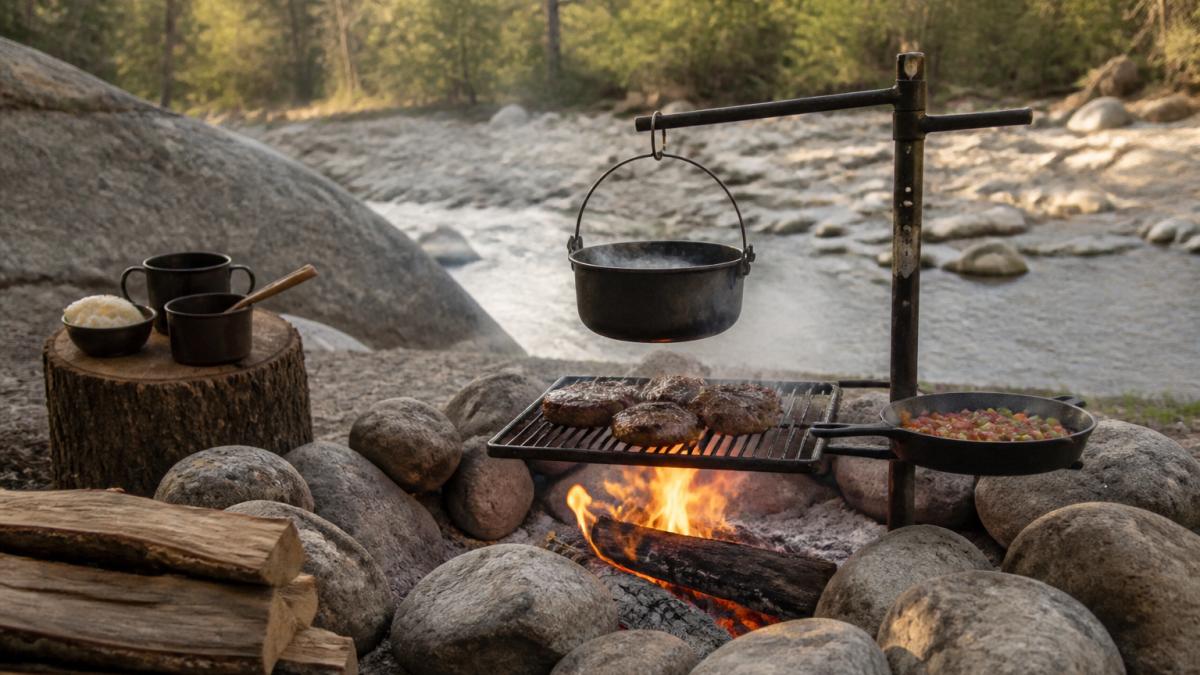
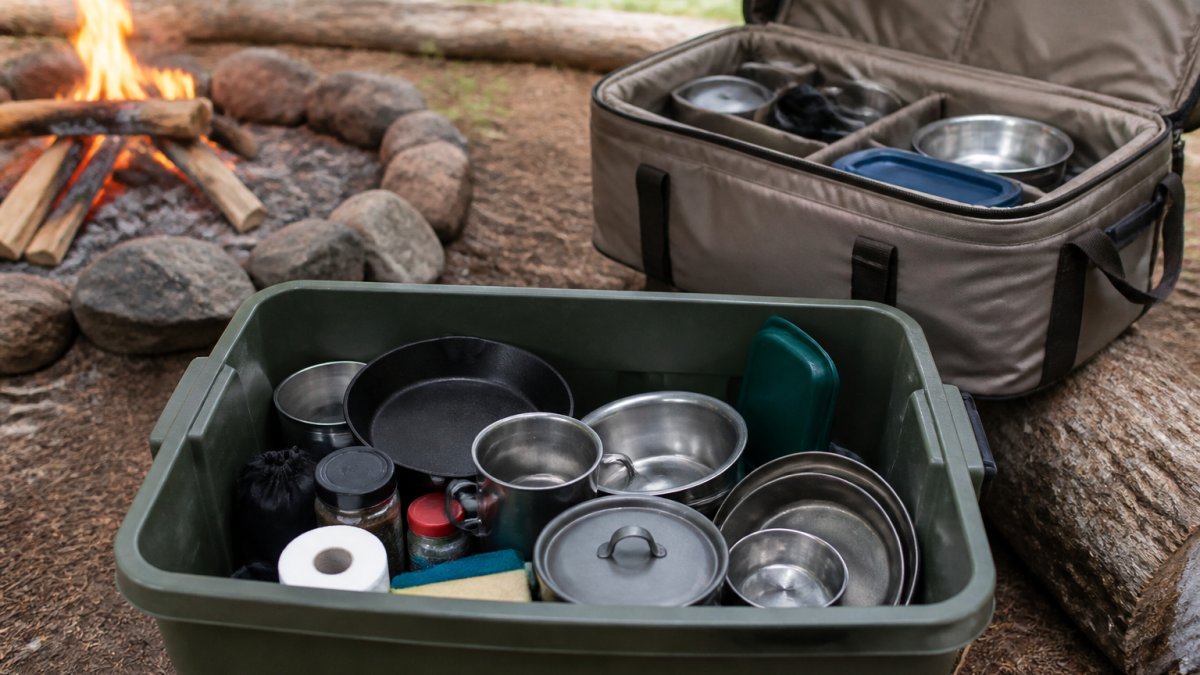
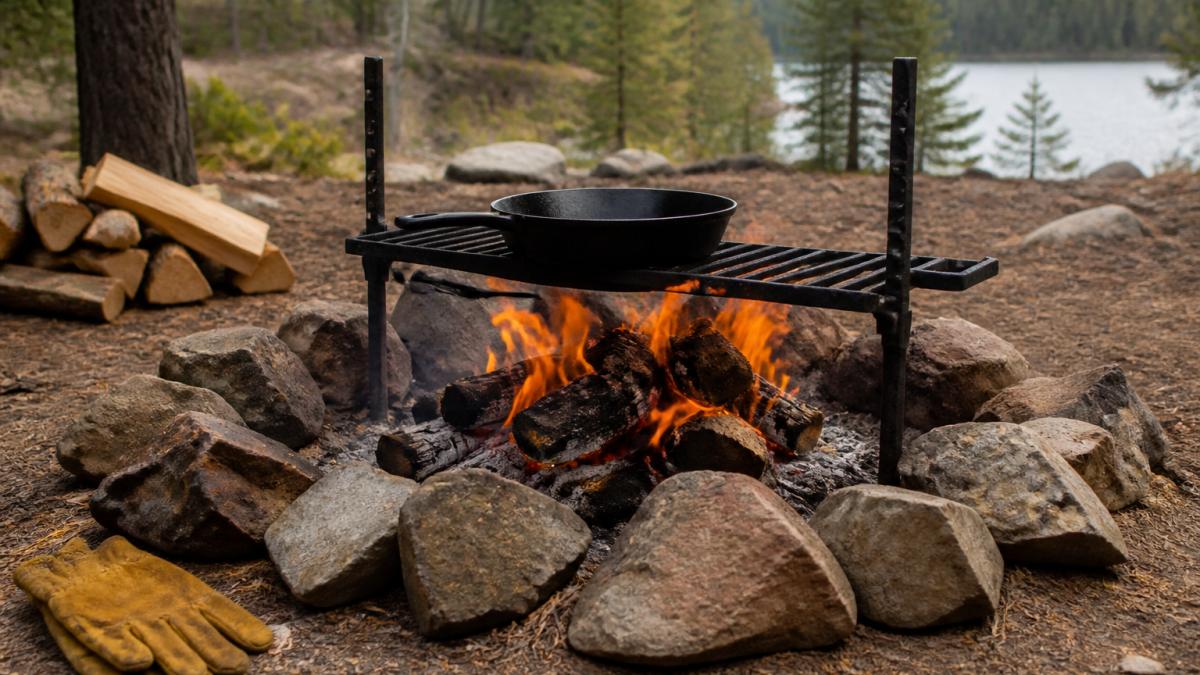
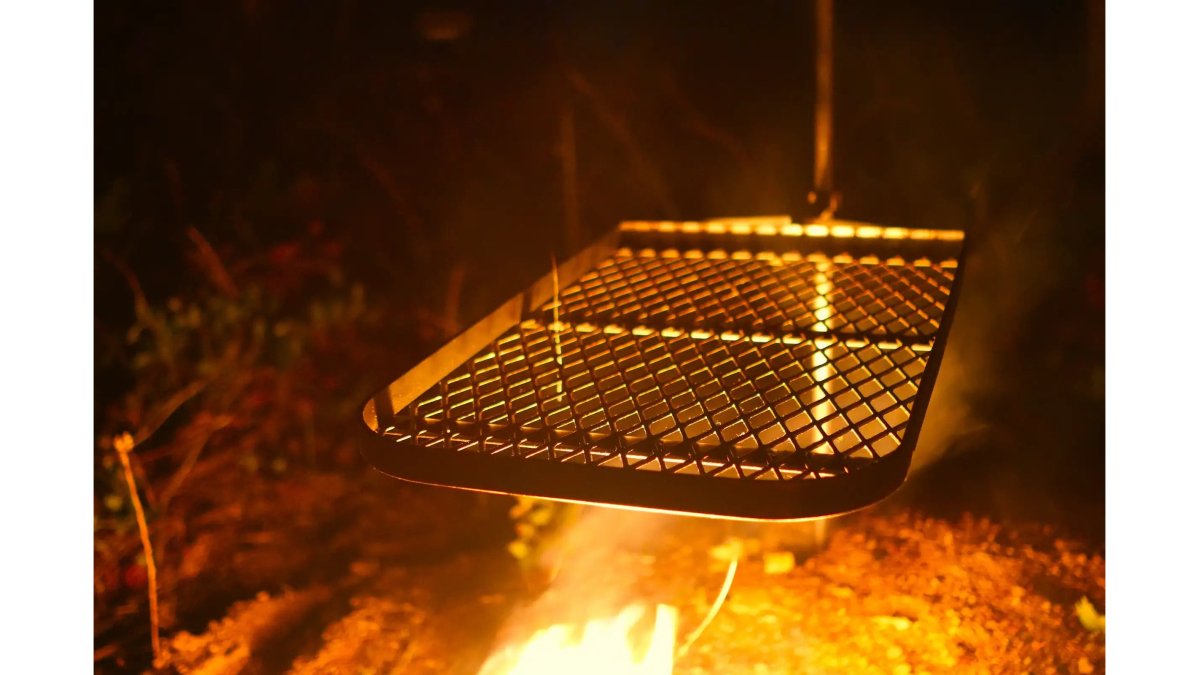
Good campfire cooking gear comes down to heat control, safe handling, and durability. A fixed grate gives you one heat setting; an adjustable grate gives you every setting between sear and slow-cook.
Tool-based safety: the kit that contains a cooking fire
Cooking fires behave differently from campfires because you are adding fat, moving hot metal, and working close to the flames. These tools are not extras, they are the containment system.

- Water bucket, filled before you light the fire. Two litres is a practical minimum. Keep it within arm's reach of the cook, not across the site.
- Shovel. A short-handled shovel moves coals, smothers flare-ups with soil, and stirs ash. It's also your fastest response to a grease flare-up: smother, don't douse.
- Fire blanket. A wool or fiberglass fire blanket smothers a grease pan fire or a flare-up on the grate without scattering embers. Store it folded and dry, and know where it is before you cook.
- Leather gloves. Handling a hot Dutch oven lid, a loaded grate, or a shifting log without gloves is how most cooking-fire burns happen. Welding-style gauntlets beat thin camp gloves.
- Long tongs and a long-handled spatula. Reach matters. Tools that keep your hands 30 cm or more from the coals prevent forearm burns.
- A lid or metal baking sheet. Covering a skillet is the fastest way to kill a grease fire at the source.
Match your containment to the environment
The same cooking setup needs different containment depending on where you are:
- Forest and bush: assume the ground is flammable even when it looks bare. Mineral soil, a rock ring, and a cleared 3-metre circle are the baseline. Keep the fire small and never cook under a canopy.
- Beach and sand: sand looks safe but holds heat and hides embers. Dig down to bare, damp sand, avoid driftwood piles, and expect wind. A trench fire with a windward berm is better here.
- Alpine and exposed sites: wind and dry grass are the hazards. Use a portable stove if a fire ban or high fire danger rating is in effect, and build only in existing rings. Stage water and a shovel upwind so embers don't reach them.
- Backyard and established firepits: the risk shifts to overhanging structures, dry landscaping, and children. Keep the grate stable, keep the fuel wood well away from the pit, and never leave a cooking fire unattended.
Managing Heat: How to Cook Over a Safe Campfire
Heat regulation separates a burnt dinner from a restaurant-quality meal. Most campfire cooking fails because the fire is too hot, not too cool; you want coals, not towering flames, for almost everything.
Build a three-zone coal bed
The most useful cooking setup is how you arrange the coals after the flames die. Push coals into three zones:
- Sear zone: a deep, tightly piled mound of coals, roughly 8 to 10 cm deep. This is your high heat.
- Cooking zone: a single, even layer of coals about 3 to 4 cm deep. This is your medium heat for most food.
- Holding zone: a bare patch of fire ring with no coals, or a thin scatter of ash. This is where food rests, finishes, or waits without overcooking.
Match the heat source to the cooking method
Different cooking methods want different parts of the fire:
- Grilling and searing: cook directly over the sear zone, 8 to 12 cm from the coals. You want a hard, fast crust.
- Skillet and griddle work: cook over the even cooking zone. The single layer of coals gives steady, moderate heat that won't scorch butter or oil.
- Dutch oven baking and braising: use the log cabin coal bed, then add coals on the flanged lid. A common ratio is roughly two parts coals on top to three underneath for baking, and the reverse for simmering. Rotate the oven a quarter turn every 15 minutes and the lid the opposite way to even out hot spots.
- Boiling and simmering: a teepee fire or a concentrated coal pile works, but keep the pot on a stable grate or tripod rather than balanced on logs.
Control heat three ways
Once your zones are set, you have three levers:
The Lifetime Warranty ANVIL Grill →
- Height: Raise the grate for less heat, lower it for more. This is the fastest adjustment and the one most cooks underuse.
- Coals: Spread coals out to lower heat, pile them together to raise it. Adding two or three fresh coals to the sear zone is faster than rebuilding.
- Air: Restrict airflow with a small berm of soil to slow the burn, or open it up to stoke the fire. Less air means longer coal life and steadier heat.
Read the heat without a thermometer
For searing, hold your hand about 10 cm above the grate: 2 seconds means high heat, while slow cooking should let you manage 5 to 6 seconds. For a Dutch oven, sprinkle a teaspoon of flour on the lid; it should brown in about a minute, not blacken in seconds.
How to Extinguish a Campfire Safely and Leave No Trace
To extinguish a campfire safely, drown it with water, stir the ashes, and drown it again. Then check that everything is cool to the touch. Most campfire escapes happen because people stop at step one.
Follow this sequence every time:
- Pour water over the fire until hissing stops
- Stir the embers and ash with a shovel, exposing buried hot spots
- Pour more water and stir again
- Feel the ashes with the back of your hand, close to the surface
- Repeat until nothing is warm
- Scatter the cooled ash and rebuild the site
Provincial Fire Ban Regulations and Campfire Safety Rules
Provincial fire ban regulations change with conditions, and they override every tip in this guide. During a ban, no open flame is allowed, including campfires, charcoal grills, and tiki torches. Cooking may be limited to portable stoves with on/off switches.
Basic rules that apply almost everywhere:
- Never leave a fire unattended
- Keep fires within designated rings where required
- Respect size limits, often around 1 metre in diameter
- Have water and a shovel within reach at all times
- Report wildfires immediately to local authorities
Common Mistakes to Avoid When Building a Cooking Fire
The mistakes that ruin campfire meals are predictable, and avoiding them takes a few minutes of planning.
Frequently Asked Questions
What is the best wood to burn on an open fire for cooking?
Hardwoods like oak, maple, and birch are ideal for cooking because they burn hot and produce long-lasting coals. Avoid softwoods like pine or cedar, which burn fast and leave little coal base. Never use pressure-treated or painted wood, as it releases toxic chemicals. Dry wood is essential; damp wood smolders and creates excessive smoke that flavors food poorly.
How do I choose a safe location for a cooking fire?
Look for a spot at least 3 metres from tents, trees, and overhanging branches. Clear a 1-metre radius of all combustibles like dry leaves, twigs, and grass. Use an existing fire ring or build a berm with rocks and mineral soil. Avoid areas with exposed roots or peat, and never build under low branches. Check wind direction to keep smoke away from your cooking area.
What gear is essential for safe campfire cooking?
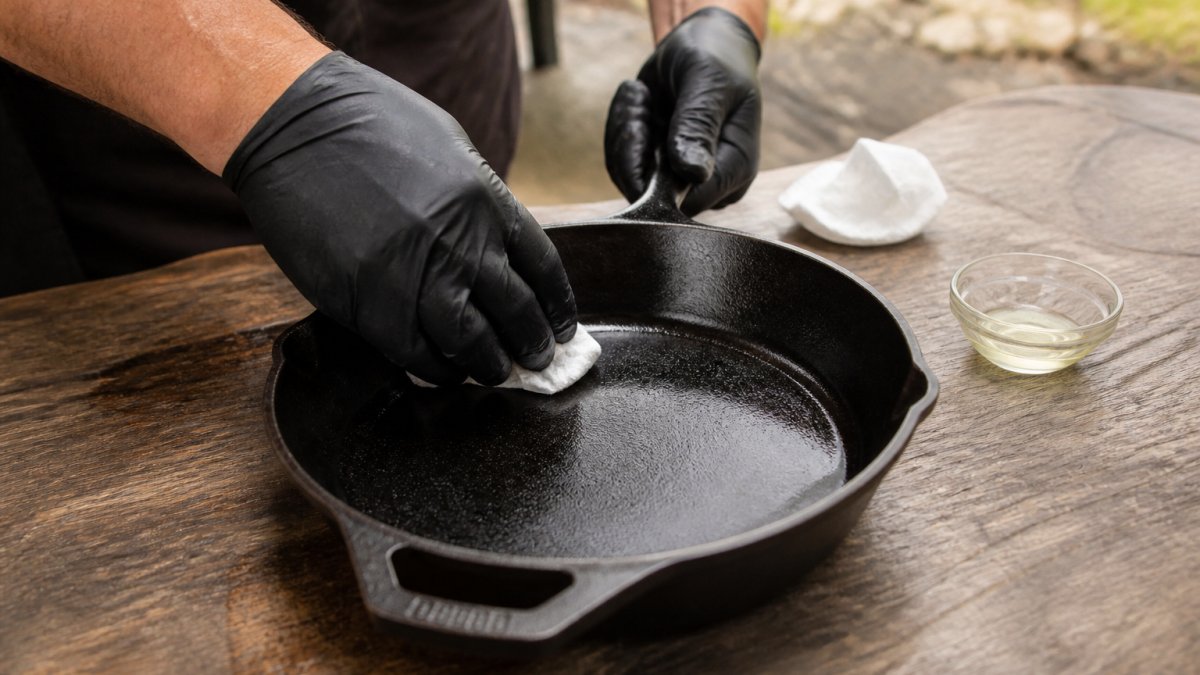
At minimum, bring a water bucket, shovel, and a fire starter. For cooking, a heavy carbon steel grill like the ANVIL adjustable grill gives you height control for heat regulation. Cast iron cookware such as a 10-inch skillet or 12-inch Dutch oven holds heat evenly. Also pack a cooking grate, heat-resistant gloves, and a lid lifter if using a Dutch oven.
How do I properly extinguish a campfire to prevent wildfires?
Start by stopping the fuel supply and letting the fire burn down to ash. Douse the embers and coals with water, stirring with a shovel to ensure everything is soaked. Repeat until the ashes are cold to the touch. Never leave a fire unattended, even for a few minutes. If water is scarce, use dirt or sand to smother the fire, then stir and check for heat.
Building a safe campfire for cooking comes down to preparation, control, and cleanup. The right gear makes all three easier, and guessing at heat is where most campfire meals go wrong. Browns Outpost gear is built for exactly this: the ANVIL Grill's adjustable height for instant heat control, hand-crafted raw carbon steel for durability, and a lifetime warranty for peace of mind. Get started with Browns Outpost and cook over fire with confidence.