 how-to
DIY Campfire Grill Grate Cleaning Hacks
Table of Contents
- Why Campfire Grate Cleaning Is Different From Backyard Grills
- Tools and Materials for DIY Campfire Grill Grate Cleaning
- Natural Grill Grate Cleaner Recipe: Baking Soda, Vinegar, and More
- Step-by-Step: How to Clean a Campfire Grill Grate at the Campsite
- How to Remove Rust From Grill Grates
- Seasoning Campfire Grill Grates After Cleaning
- Long-Term Care for Cast Iron and Carbon Steel Grates
- Frequently Asked Questions
Last Updated: September 21, 2026
Why Campfire Grate Cleaning Is Different From Backyard Grills
Campfire grate cleaning is harder than backyard grill maintenance: no hose, no sink, no soaking, plus soot, ash, and uneven heat that bakes carbon onto the metal.
Tools and Materials for DIY Campfire Grill Grate Cleaning
The right kit is small and light, no full cleaning caddy in the backcountry. Pack these basics:
- A stiff wire brush with a metal scraper
- A scour pad for stubborn spots
- Baking soda in a small sealed bag
- A spray bottle of white vinegar
- A rag or two, plus aluminum foil
- A little dish soap for greasy grates
- A small bottle of neutral oil for seasoning
What to Pack for Field Cleaning
Weight matters when you hike in. Keep your cleaning kit under a pound.
- Wire brush: 100-150 g
- Baking soda: 50 g in a zip bag
- Vinegar: 100 ml in a leak-proof bottle
- Scour pad: one, cut in half
- Oil: 50 ml for post-clean seasoning
Natural Grill Grate Cleaner Recipe: Baking Soda, Vinegar, and More
A natural grill grate cleaner recipe uses baking soda and white vinegar to lift grease without harsh chemicals, non-toxic, cheap, and safe around food. Here is the base recipe:
- 3 parts baking soda
- 1 part water
- A splash of white vinegar
Step-by-Step: Mixing and Applying the Paste
- Scoop baking soda into a bowl or cup.
- Add water slowly and stir into a paste.
- Stir in a splash of vinegar.
- Apply a thick layer to the cool grate.
- Let it sit 15-30 minutes.
- Scrub with a scour pad or wire brush.
- Rinse with clean water and dry on heat.
Step-by-Step: How to Clean a Campfire Grill Grate at the Campsite
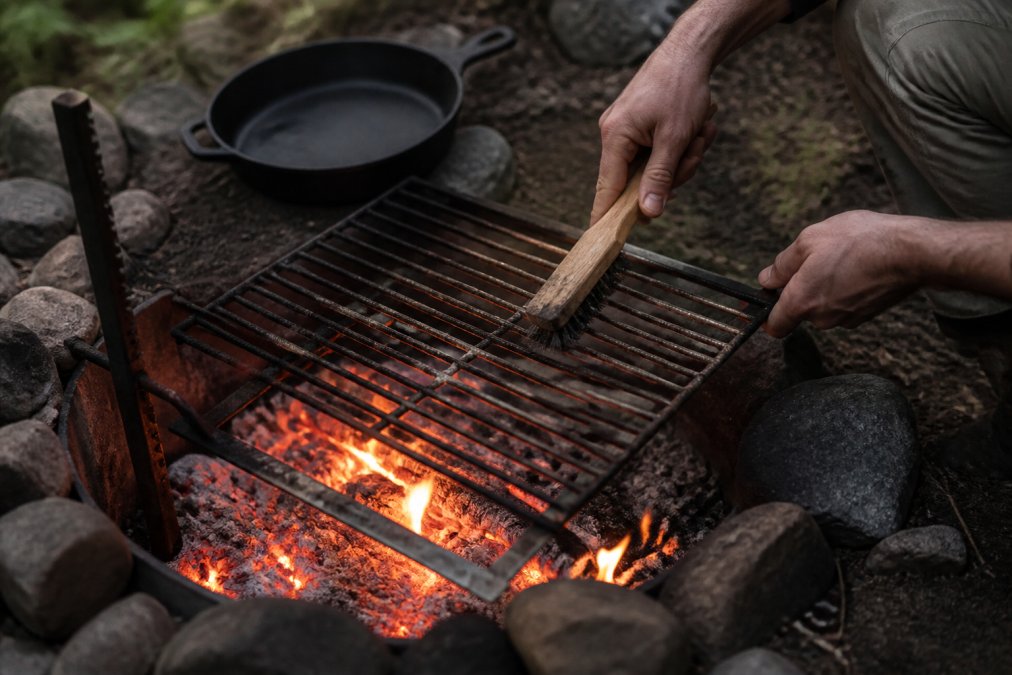
Cleaning a campfire grate at the campsite takes about 20 minutes: burn, brush, paste, rinse, dry, oil. Heat does most of the work, so start there, with open fire, limited water, and no hose, every step has to earn its place.
The Burn-Off: Your First and Best Cleaning Tool
A hot fire burns off grease and carbon residue better than any scrub pad, the single biggest advantage campfire cooking has over backyard grilling.
- Build a hot fire and let it burn down to coals, glowing embers, not leaping flames, since flames deposit soot while coals radiate steady heat.
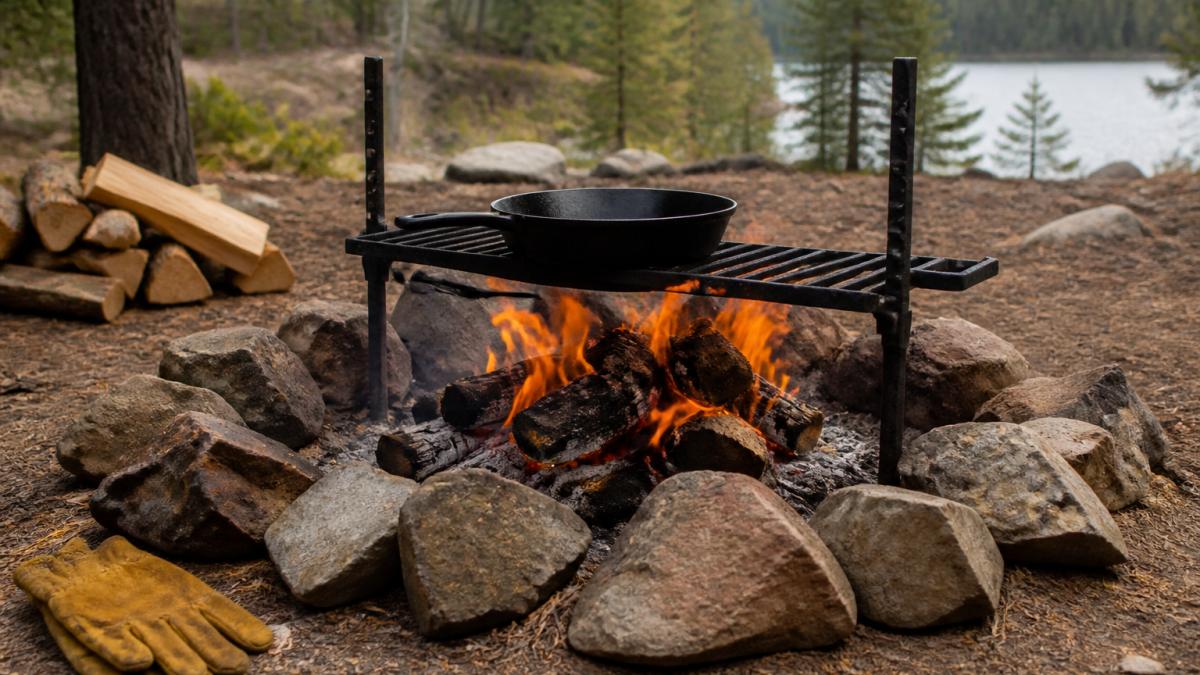
- Lay the grate directly over the coals for 10-15 minutes until the residue carbonizes and flakes gray and powdery.
- Pull the grate off with channel-lock pliers, a green stick, or a grate lifter, never your hands.
- Let it cool just until you can hold it with a thick glove; scrubbing while warm is easier because the carbon is brittle.
The Scrub: Wire Brush and Paste
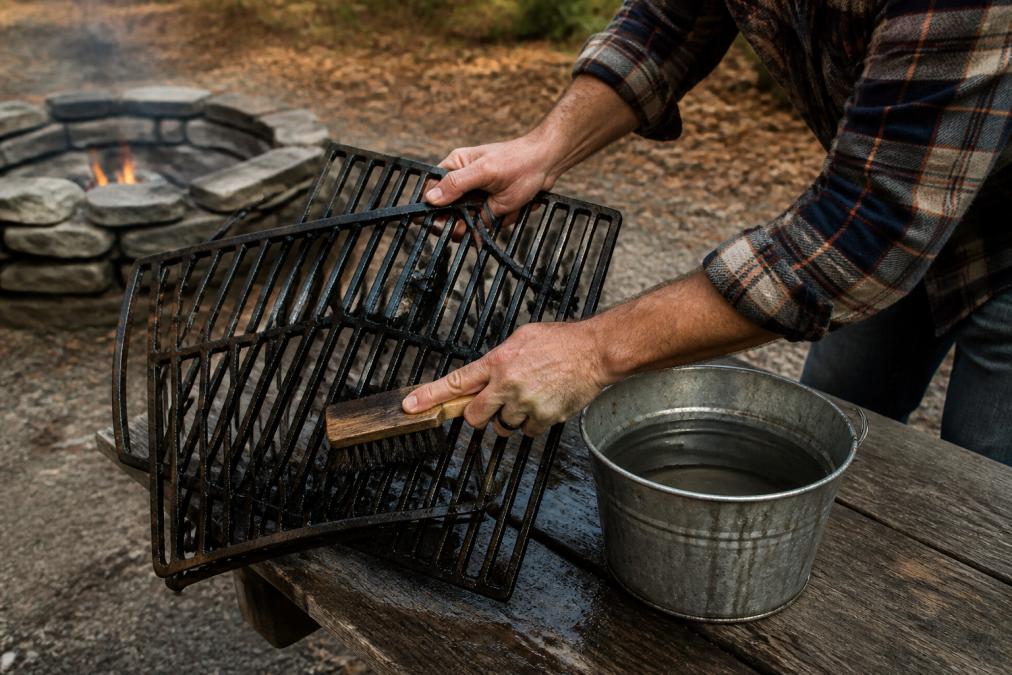
- Scrub both sides with a stiff wire brush while the grate is still warm, working in short strokes with the grain; a metal scraper on the handle knocks off big flakes first.
- Apply the baking soda paste (3 parts baking soda, 1 part water, splash of vinegar) to stubborn spots and let it sit 15-30 minutes.
- Scrub again with a scour pad; for heavy carbon use a stainless steel scour pad, but only on stainless steel grates, cast iron and carbon steel need a gentler hand.
- Rinse with clean water, using as little as possible in the backcountry; catch runoff in a pot in sensitive areas.
The Dry and Oil: Preventing Rust on the Spot
- Dry the grate over the fire for 2-3 minutes, never air-dry, since moisture plus ash equals rust on campfire equipment.
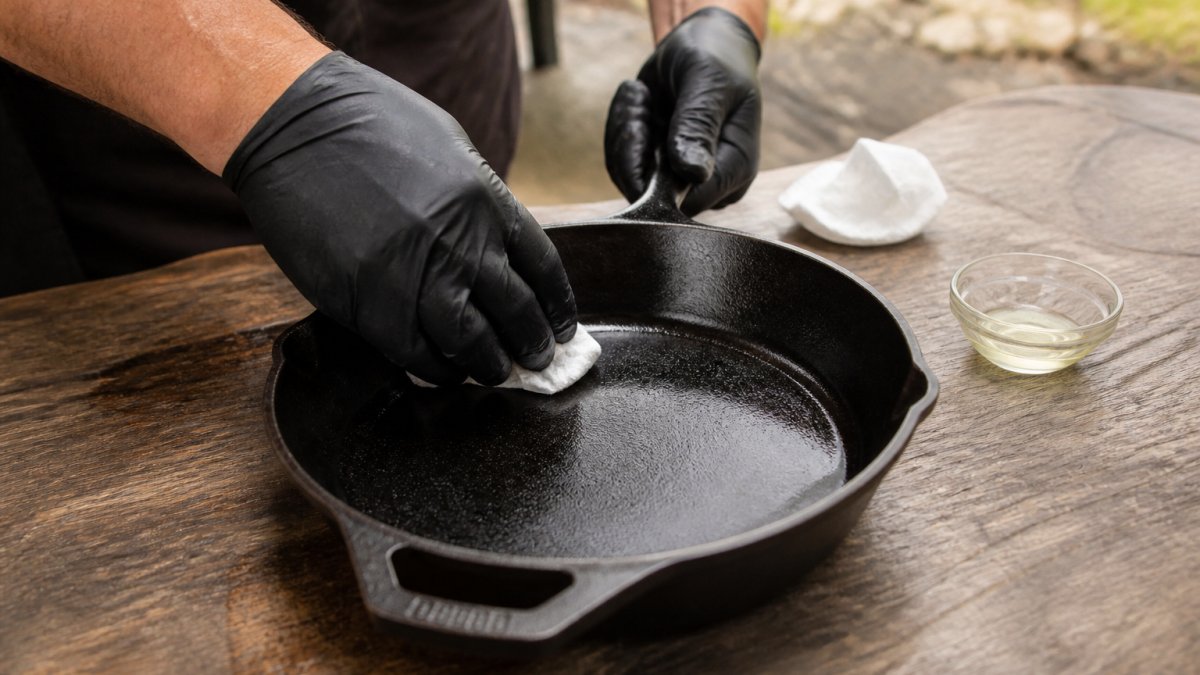
- Wipe on a thin coat of neutral oil while the grate is still warm; the heat opens the metal's pores and helps the oil bond. You want a sheen, not a puddle.
Emergency Field Cleaning Hacks
No brush, no baking soda, no problem, these field hacks use what you already have and will get you cooking again, though they are not as thorough as a full clean.
- Aluminum foil scrubber: Crumple foil into a tight ball; the edges create a mild abrasive that lifts soot and grease, best on warm metal.
- Sand and rag: Wet a rag, dip it in fine sand, and scour the grate, then rinse thoroughly so no grit ends up in your food.
- Green stick scraper: Split a green stick and use the edge, soft enough not to gouge metal, stiff enough to push off carbon.
- Onion or lemon rub: Rub a cut onion or lemon on a warm grate; the acid loosens grease and leaves a faint scent. A surface fix, not a deep clean.
- Ash paste: Mix wood ash with water; its potassium carbonate is mildly caustic and cuts grease. Scrub with a rag, then rinse.
- Burn and wipe: With nothing else, burn the grate clean over a hot fire, then wipe with a rag or dry grass.
How to Remove Rust From Grill Grates
To remove rust from grill grates, scrub the spots with a scour pad and baking soda paste, then re-season right away, rust forms fast on campfire grates because of damp air and ash residue. Here is the fix:
- Mix baking soda and water into a paste.
- Rub it into the rust with a scour pad.
- For heavy rust, soak the grate in white vinegar for a few hours.
- Scrub again until the metal is bare.
- Rinse and dry on heat.
- Oil the grate while still warm.
Seasoning Campfire Grill Grates After Cleaning
Seasoning campfire grill grates rebuilds the protective oil layer that cleaning strips away. Do it every time you clean, or rust wins.
The process is short:
- Warm the clean, dry grate over the fire.
- Wipe on a thin coat of neutral oil.
- Let it heat until it just starts to smoke.
- Pull it off and let it cool.
- Repeat once more for a stronger layer.
Long-Term Care for Cast Iron and Carbon Steel Grates
Cast iron and carbon steel need the same core care: keep them dry, keep them oiled, and never leave them in the rain. But they are not identical, and treating them the same way will shorten the life of your gear.
Cast Iron vs. Carbon Steel vs. Stainless Steel: What Actually Differs
Cast iron is thick, heavy, and slow to heat, holding heat for searing and baking, but it is brittle enough to crack on a rock, and its rough, porous surface traps moisture if you do not dry it thoroughly.
The Post-Cleaning Seasoning Step Most Guides Skip
This is the gap: most guides tell you to clean your grate and put it away, which is how rust starts. After every deep clean, especially after baking soda paste or vinegar, you must re-season, because cleaning strips the protective oil layer and leaves bare metal exposed to air and moisture. Here is the full re-seasoning process:
- Warm the grate over the fire until hot but not glowing, so the metal opens its pores.
- Wipe on a thin coat of neutral oil, flaxseed, canola, or grapeseed. You want a sheen, not a drip.
- Let it heat until it just starts to smoke, the polymerization point, where the oil bonds into a hard, protective layer. Do not let it catch fire.
- Pull it off and let it cool so the seasoning sets.
- Repeat once more, two thin coats beat one thick coat, which turns gummy and attracts grime.
Long-Term Care Habits That Actually Matter
- Dry on heat after every wash. Never air-dry; hold the grate over coals or a camp stove until every trace of moisture is gone.
- Oil after every use. A thin coat is the single best rust preventive and takes 30 seconds.
- Store in a dry bag or wrap in cloth. A canvas sleeve or cotton towel beats a bare grate sitting in damp truck air.
- Re-season when the surface looks dull. Gray or chalky instead of dark and smooth means the seasoning is wearing thin.
- Check for rust before each trip. Surface rust is easy to fix; deep pitting means the metal is worn.
- Avoid soaking. Cast iron and carbon steel should never sit in water; if you must soak stubborn carbon, use hot water for 10 minutes maximum, then dry immediately on heat.
- Do not use dish soap on seasoned metal. Soap strips seasoning, hot water and a brush are enough. Reserve soap for stainless steel or a full reset.
When to Replace Your Grate
The Lifetime Warranty ANVIL Grill from Browns Outpost is built for exactly this kind of care. Its carbon steel grate is acid-bathed and pre-seasoned with olive oil, so it starts ready to cook. It packs flat, stakes into the ground, and adjusts to any height over the fire.

Frequently Asked Questions
What is the best homemade cleaner for campfire grill grates?
A baking soda paste with water is the most effective homemade cleaner for campfire grill grates. Mix three parts baking soda with one part water, apply it to the grate, and let it sit for 15 minutes. Scrub with a wire brush or scour pad, then rinse. For heavy carbon buildup, add white vinegar to create a fizzing action that lifts residue.
How can I naturally clean my grill grates without harsh chemicals?
Use a natural grill grate cleaner recipe: combine baking soda, white vinegar, and a little dish soap. Apply the paste, let it sit, then scrub with a scour pad. For a chemical-free option, cut an onion in half and rub it on hot grates, or use aluminum foil crumpled into a ball as an abrasive. These methods avoid residue that can transfer to food.
How do you remove rust from grill grates?
To remove rust from grill grates, start by scrubbing with a wire brush or steel wool. For deeper rust, make a paste of baking soda and water, apply it, and let it sit for 30 minutes before scrubbing. Rinse and dry immediately. After cleaning, season the grate with a thin coat of oil to prevent rust from returning. For carbon steel grates, regular seasoning is key.
How do you season campfire grill grates after cleaning?
After cleaning, dry the grate completely and apply a thin layer of neutral oil, such as canola oil. Heat the grate over the fire until the oil smokes, then let it cool. Repeat this process two or three times for a strong seasoning layer. This protects against rust and creates a non-stick surface for future cooking.
A dirty grate ruins the cook, and rust ruins the gear. Browns Outpost makes carbon steel cookware built to survive fire, rain, and years of trips, all backed by a lifetime warranty. The ANVIL Grill adjusts to any height, packs flat, and cleans up with the same simple routine you just read. Get started with Browns Outpost and cook over open fire with gear that lasts.