 comparison
Easy to Use Luxury Outdoor Living: Gear That Works
Table of Contents
- Why Easy to Use Matters More Than Ever in Luxury Outdoor Living
- Durable Outdoor Furniture and Weather-Resistant Materials That Last
- The Adjustable Campfire Grill: One Tool, Every Technique
- Low-Maintenance Outdoor Living: Care Routines That Take Minutes
- Camp Kitchen Setup for Long Trips: What to Pack and How to Organize It
- Side-by-Side Comparison: Browns Outpost Outdoor Cooking Gear
- Long-Term Ownership Costs and What You Actually Save
- Conclusion: Build an Outdoor Space That Works for You
- Frequently Asked Questions
Last Updated: October 16, 2026
Why Easy to Use Matters More Than Ever in Luxury Outdoor Living
Easy to use for luxury outdoor living comes down to one thing: gear that performs without demanding your attention. At Browns Outpost, we build outdoor cooking equipment around that principle, because the best patio setup is the one you actually use.
The shift is practical, not aspirational. People want an upscale outdoor room they can enjoy on a Tuesday night, not just when guests visit. That means fewer moving parts, faster cleanup, and materials that shrug off rain, frost, and sun.
This guide covers what makes luxury outdoor living genuinely easy to use: durable outdoor furniture, weather-resistant materials, an adjustable campfire grill, and a camp kitchen setup for long trips, plus long-term ownership costs, because "easy" should still make sense five years from now.
Durable Outdoor Furniture and Weather-Resistant Materials That Last
Durable outdoor furniture starts with materials that tolerate freeze-thaw cycles, UV exposure, and constant moisture. An elegant showroom piece can crack, fade, or rust within two seasons if the construction is wrong, the real test is how a set behaves after a winter of snow load, a spring of rain, and a summer of direct sun.
Here is how the main material categories compare for a patio or garden setting:
| Material | Weather Resistance | Maintenance Level | Best For |
|---|---|---|---|
| Powder-coated aluminum | High, resists rust | Wipe-down only | Sectionals, dining chairs |
| Teak and acacia | High, ages gracefully | Annual oiling | Benches, dining tables |
| Wicker and resin weave | Moderate to high | Rinse, occasional tightening | Conversation areas |
| Wrought iron | High, but heavy | Touch-up paint | Porch swings, fire tables |
| Water-resistant cushions | Depends on fabric | Store or cover in winter | All seating |
The details that decide longevity are rarely visible. Welded frames beat bolted ones, solution-dyed fabrics hold color better than surface-dyed, and stainless hardware resists rust where painted steel will not. Powder coating should sit over a properly pretreated aluminum frame; if it chips, corrosion starts at the chip edge. Teak and acacia contain natural oils that slow rot, but those oils deplete, so annual oiling matters more in wet coastal climates than dry interior ones.
How Materials Perform Across Canadian Conditions
Weather resistance is a set of responses to stresses that differ by region.
- Freeze-thaw: Water seeping into hairline cracks in resin weave or unsealed wood expands when it freezes, widening the crack. Pieces that drain freely and use sealed construction survive better than those that trap water in joints or hollow legs.
- Coastal salt air: Salt accelerates corrosion on any ferrous metal, including lower-grade stainless steel. Rinsing frames with fresh water a few times a season is the simplest countermeasure.
- Humidity: Prolonged dampness encourages mildew on cushions and mold on untreated wood. Solution-dyed acrylic and olefin resist mildew better than cotton blends, and quick-drying foam cores shrink the window for mildew.
- UV exposure: Surface-dyed fabrics fade from the outside in, while solution-dyed fabrics carry color through the fiber, the more durable choice for a set in all-day sun.
Ease-of-Use Criteria for Luxury Outdoor Living
Most roundups showcase products or inspiration. The keyword, though, is easy to use, which comes down to a short list:
- Setup and assembly: Look for pre-assembled or tool-light assembly. A sectional arriving in six boxes that takes an afternoon to build is not easy to use, however comfortable.
- Adjustability: Reclining backs, adjustable armrests, and stackable or nesting pieces let one set serve lounging, dining, and conversation without rearranging the patio.
- Storage and covers: Pieces that stack, fold, or accept a fitted cover in under a minute are far more likely to be protected before a storm. If covering takes twenty minutes, it will not happen.
- Cleaning access: Removable, machine-washable cushion covers and crevice-free frames cut cleaning time dramatically.
- Movement: Glides on the feet protect deck boards and let one person reposition heavy pieces.
Accessibility and Inclusive Usability
A genuinely easy-to-use outdoor space works for different bodies and mobility needs. Seat height is the starting point: chairs around 17 to 19 inches are easier to enter and exit than low lounge seating, and armrests provide a stable push-off point. Firm, level surfaces and wide pathways reduce trip risk and make the space navigable with a cane, walker, or wheelchair. Firm cushions are easier to rise from, even if less plush at first sit.
Coordinating a Complete Outdoor-Living System
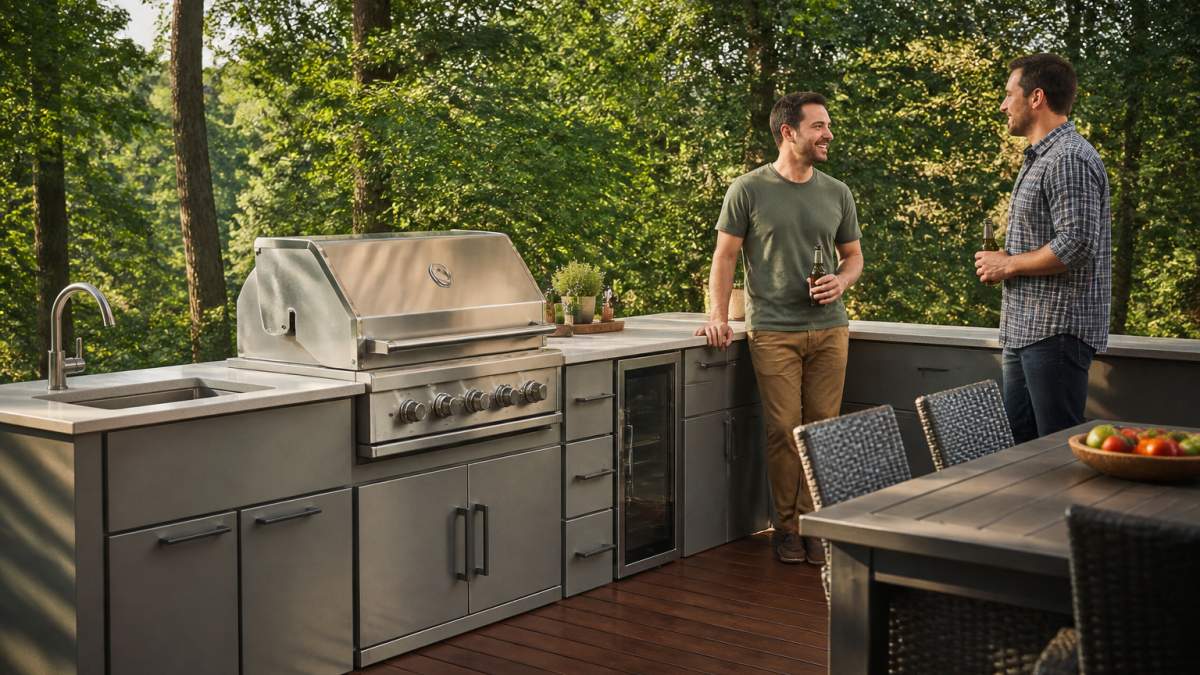
Individual furniture categories are easy to buy and hard to coordinate. A complete system treats seating, dining, shade, lighting, and storage as one plan: keep circulation paths at least 36 inches wide, place dining within a few steps of the kitchen or grill, position shade over the seating area at the hottest part of the day, and choose lighting that turns on with one switch or motion sensor. Storage should sit within arm's reach of where cushions and covers are used, because the shorter the distance, the more likely the routine is followed.
For anyone building a full outdoor living room, the goal is a set where every piece shares the same finish and material logic. Mixed materials can look intentional, but mixing maintenance routines usually means one piece gets neglected.
The Adjustable Campfire Grill: One Tool, Every Technique
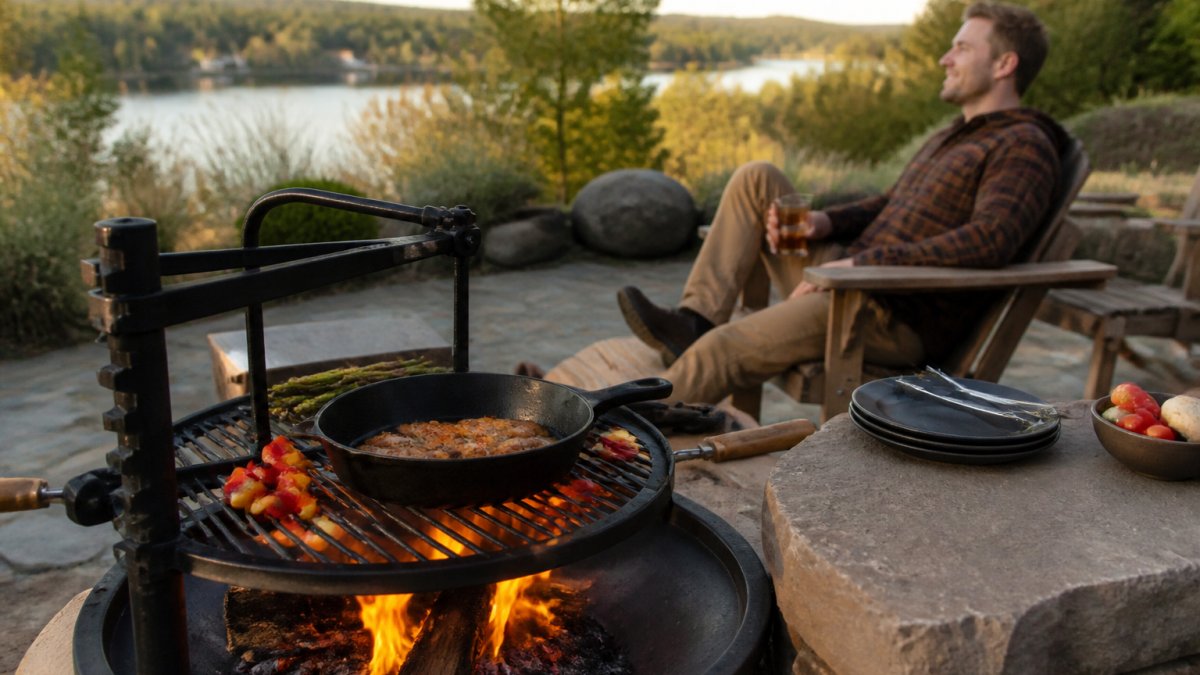
An adjustable campfire grill replaces a shelf of single-purpose tools with one piece of gear that handles searing, slow cooking, and everything between. The Browns Outpost ANVIL Grill uses a heavy carbon steel grate that slides and locks along a stake, so you set the height above the flame and cook with precision.

That adjustability is the whole point: lower the grate for a hard sear, raise it for low-and-slow cooking. The 15 x 20 inch surface handles a full meal, and the frame holds 40 lb without flexing. It stakes into the ground over a campsite ring, fire pit, or backyard bonfire, no assembly, no bulky case.
The surface is acid-bathed and pre-seasoned with olive oil, with no chemical coatings. Care takes minutes: burn off residue over the fire, brush the grate while warm, oil it lightly, and store it dry.
Low-Maintenance Outdoor Living: Care Routines That Take Minutes
Low-maintenance outdoor living is a routine, not a product. A few short habits keep furniture, cushions, and cookware in shape and prevent the slow damage that turns a five-minute job into a weekend project.
For Browns Outpost cast iron and carbon steel, the routine is the same across every piece:
- Rinse with hot water only, no soap needed
- Dry immediately on heat so no water spot gets a chance to rust
- Re-oil with a thin coat of neutral oil after every wash
- Never put cast iron in the dishwasher, which strips seasoning in one cycle
Health Canada's guidance on safe outdoor cooking and food handling is worth a read before your first big cook of the season, particularly for anyone cooking for a group.
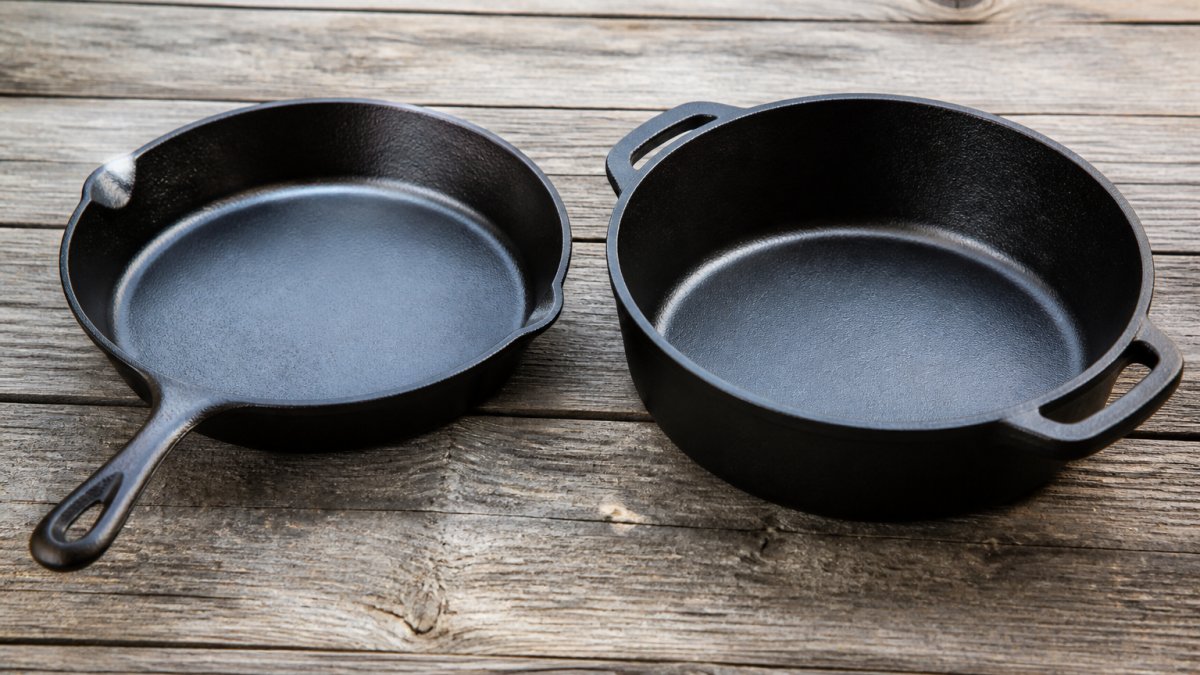
Cast iron is often called high-maintenance. In practice, it is the opposite: a well-seasoned pan is more non-stick and more forgiving than thin steel, and it does not warp over a raging fire. Browns Outpost cast iron cookware is built to hold heat and resist warping.
Camp Kitchen Setup for Long Trips: What to Pack and How to Organize It
A camp kitchen setup for long trips works when every item has one job and one place. Packing for a week differs from a weekend mostly in organization, not volume.
The Lifetime Warranty ANVIL Grill →
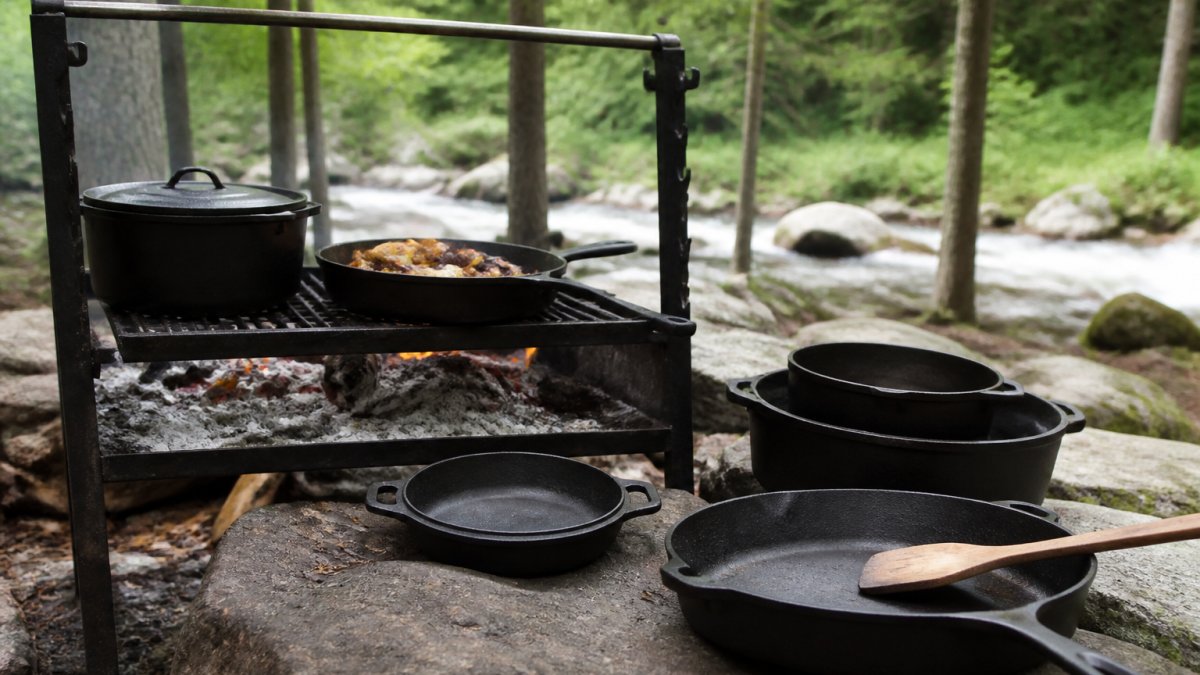
Start with the cookware that covers the most meals:
- 12" Dutch Oven ($52.99): braises, stews, chili, and bread baked under coals on the flanged lid
- 12" Roasting Pan ($48.99): deep walls catch drippings for a pan sauce, and it sears a ribeye like a steakhouse pan
- 10" Cauldron with Reversible Lid ($45.99): one-pot meals, with the lid flipped flat-side up as an extra griddle
- The ANVIL Grill ($174.99): the cooking surface for everything over open flame
- 16 oz Tumbler ($19.99): spill-proof and insulated, for coffee at the trailhead or cider at the fire
Organize by function, not by item: one bin for fire and cooking surfaces, one for dry goods, one for cleaning, with daily-use pieces on top. Browns Outpost gear packs down flat or nests, which matters when space is tight.

Side-by-Side Comparison: Browns Outpost Outdoor Cooking Gear
Choosing gear is easier with the specs in one place. Every Browns Outpost piece carries a lifetime warranty against manufacturing defects and ships free over $75 CAD.
| Product | Price (CAD) | Material | Best For | Key Feature |
|---|---|---|---|---|
| ANVIL Grill | $174.99 | Heavy carbon steel | Grilling over any open fire | Adjustable height, 15 x 20 in surface |
| 12" Roasting Pan | $48.99 | Cast iron | Searing, pan sauces | Deep walls catch drippings |
| 12" Dutch Oven | $52.99 | Cast iron | Braises, stews, camp bread | Flanged lid holds coals |
| 10" Cauldron | $45.99 | Cast iron | One-pot meals | Reversible lid doubles as griddle |
| 16 oz Tumbler | $19.99 | Insulated stainless steel | Drinks on the move | Spill-proof lid |
The ANVIL is the anchor piece; everything else builds around it. Starting from nothing, buy the grill first, then the dutch oven, then the roasting pan.

One customer put it plainly: "This grill has completely changed over-the-fire cooking for me. I have never had a grill this strong and durable, it's super versatile and easily holds an entire rear quarter from a deer" (Dan D.).
Long-Term Ownership Costs and What You Actually Save
Long-term ownership costs favor gear you buy once. A cheap grill that rusts out in two seasons costs more than a carbon steel one that lasts decades, even though the sticker price looks higher on day one. Replace a budget grill every third summer and you have spent more than the ANVIL's $174.99 within a few years, with nothing to show for it. The same logic applies to Browns Outpost cast iron: a $52.99 dutch oven that outlives the trip, the season, and probably the truck is the cheaper option over any realistic timeline.
But purchase price is only part of the picture. The costs that surprise owners are the recurring ones.
The Recurring Costs Most Buyers Forget
- Replacement cushions: Cushions are the first thing to fail on a patio set. Even water-resistant fabrics eventually fade, flatten, or mildew, and replacing a full set can approach the cost of the original seating. Solution-dyed fabrics and quick-drying foam cores extend the interval but do not eliminate it.
- Covers and storage: A fitted cover is a small cost that prevents a large one, though covers themselves degrade under UV and typically need replacing every few seasons. Indoor or covered winter storage avoids the cost entirely, if the space exists.
- Cleaning and refinishing: Teak oil, touch-up paint for wrought iron, and mild cleaners for powder-coated aluminum are modest annual expenses. Skipping them shifts cost from maintenance to replacement.
- Hardware and fasteners: Bolts, glides, and clips are inexpensive individually but add up across a large set, and sourcing matching hardware years later can be difficult.
- Fuel and consumables: Charcoal, propane, and seasoning oil are ongoing but predictable and small compared with furniture upkeep.
A Simple Way to Compare Options
A useful rule of thumb is to estimate cost per season rather than cost per purchase: take the purchase price, add expected annual upkeep, and divide by the seasons you realistically expect the piece to last. A lower-priced item with a short lifespan and high upkeep often lands higher per season than a higher-priced item with a long lifespan and minimal upkeep.
The lifetime warranty against manufacturing defects changes the risk calculation further. You are not buying a disposable product with a one-year window, but a piece of gear with a repair-or-replace commitment behind it, removing the most expensive failure mode: replacing a product that failed early through no fault of your own.
Where does the money actually go? Into materials and construction: heavy carbon steel, hand-crafted surfaces, and a design that stakes into the ground without a frame to bend. That is what you pay for over a mass-market alternative, and it keeps the cost per season low over the life of the piece.
Conclusion: Build an Outdoor Space That Works for You
The hardest part of building an outdoor space is resisting the temptation to fill it with gear that looks good and gets used twice. Easy to use for luxury outdoor living means every piece earns its place, from the sectionals on the patio to the grill at the fire pit.
Browns Outpost builds gear for exactly that standard: a lifetime warranty, hand-crafted raw carbon steel, the adjustable ANVIL campfire grill design, and free shipping over $75 CAD. The result is outdoor cooking that delivers professional results without a steep learning curve.
Get started with Browns Outpost and build an outdoor space you will actually use, season after season.
Frequently Asked Questions
What makes outdoor cooking equipment easy to use for luxury outdoor living?
The biggest factors are adjustable heat control, minimal setup, and easy cleanup. An adjustable campfire grill lets you raise or lower the grate to control temperature without moving coals. Cast iron cookware goes from fire to table and cleans with hot water and a brush. When gear is designed for one-handed height changes and hand-wash care, you spend less time fiddling and more time enjoying the fire.
What is the most durable outdoor furniture for everyday use?
Look for materials that handle freeze-thaw cycles, UV exposure, and rain without warping or fading. The key is checking the construction and drainage, not just the surface finish.
How do you organize a camp kitchen for a long trip?
Start with a camp kitchen setup for long trips built around one or two multi-use pieces instead of many single-purpose tools. A 12-inch Dutch oven handles braises, stews, and bread. A 10-inch cauldron with a reversible lid gives you a pot and a griddle in one. Pack a dedicated tote for dry goods, a separate bin for cast iron, and a small bag for utensils and oil. Label everything so anyone in your group can find what they need.
What should you look for in adjustable campfire cooking equipment?
Check three things: height range, stability, and material. The grate should slide and lock at multiple heights so you can sear close to the flame or slow-cook higher up. It needs to stake securely into the ground or sit steady on a fire ring. Carbon steel holds heat well and seasons over time. Browns Outpost's ANVIL Grill offers 38 x 50 cm of grilling surface, handles 20 kg, and packs flat for transport at $174.99 CAD.
How can you keep outdoor cooking gear organized and ready to use?
Clean and oil cast iron immediately after each use, then store it dry with a paper towel between the lid and pot to absorb moisture. Keep your adjustable campfire grill in a dedicated spot so you always know where it is. A simple routine of burn-off, brush, oil, and store takes about five minutes and prevents rust. Low-maintenance outdoor living starts with gear that rewards a small amount of consistent care.