 comparison
Is a Modular Outdoor Kitchen Worth the Cost?
Table of Contents
- What Makes Modular Outdoor Kitchens Different
- Modular Outdoor Kitchen Cost: What You Actually Pay
- Modular vs Custom Outdoor Kitchen: The Real Trade-Offs
- Outdoor Kitchen Disadvantages You Should Know
- Outdoor Kitchen Maintenance: Time and Money Over Time
- Who Benefits Most From Modular Systems
- The Durability Question: Will It Last?
- Frequently Asked Questions
Last Updated: October 4, 2026
What Makes Modular Outdoor Kitchens Different
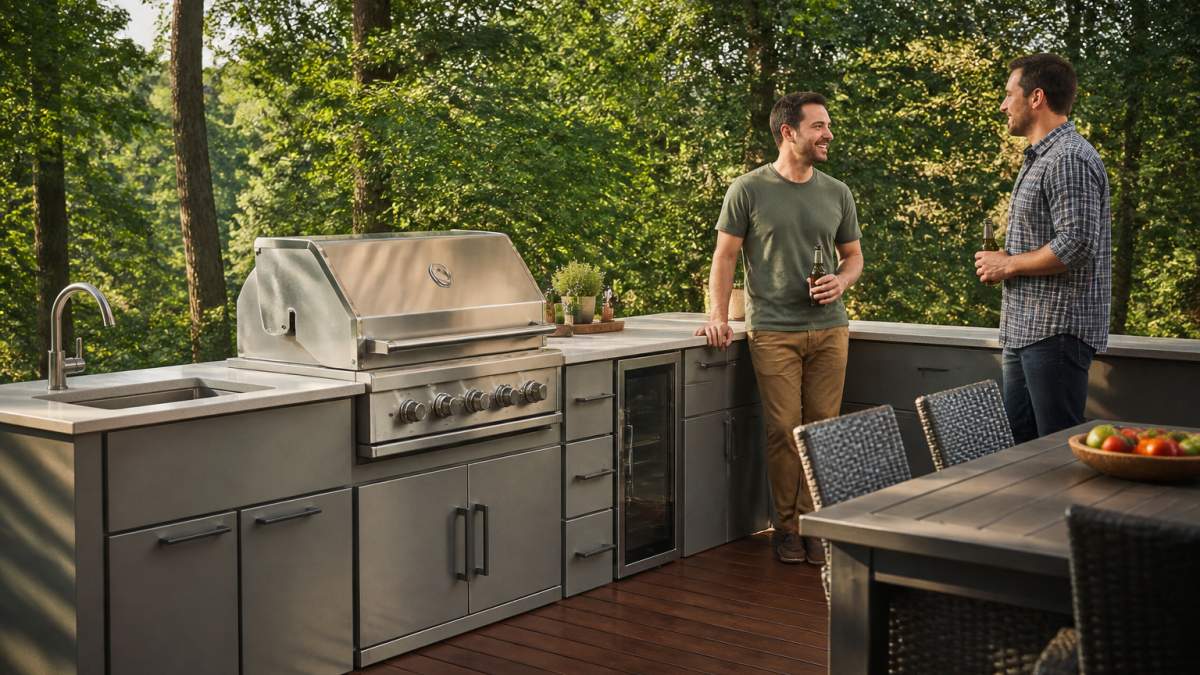
A modular outdoor kitchen is a pre-assembled system of individual units, grill, countertop, storage, and appliances, that connect together rather than being custom-built from scratch, but is a modular outdoor kitchen worth the cost? The key difference from traditional outdoor kitchens is flexibility. You can rearrange units, add pieces over time, or move the entire setup if you relocate.
Custom kitchens are built in place with permanent foundations; modular systems arrive mostly ready to install and suit backyards where permanent structures aren't practical.
Modular kitchens offer faster installation, lower upfront labor costs, and gradual expansion, but trade durability, customization, and long-term value for that convenience.
Modular Outdoor Kitchen Cost: What You Actually Pay
The upfront price of a modular outdoor kitchen typically ranges from $3,000 to $15,000 depending on size and components. A basic two-unit system (grill plus counter space) starts around $3,000-$5,000. A full kitchen with refrigeration, multiple cooking surfaces, and storage runs $10,000-$15,000 or higher.
Installation costs are where modular saves money compared to custom builds. Most modular systems require only a level surface and basic connections for gas, water, and electricity. Labor typically runs $500-$2,000, depending on how much site preparation is needed. Custom kitchens often cost $5,000-$10,000 just for installation and foundation work.
The purchase price is only the beginning. Total cost of ownership reveals what most buyers overlook:
Delivery and assembly: Delivery fees range from $200-$800; assembly labor adds $300-$1,000.
Utility connections: Gas line installation costs $400-$1,500; water and drain $300-$1,200; electrical $200-$800. These are often underestimated because they're not included in appliance pricing.
Protective covers and storage: Weatherproof covers cost $150-$400 and last 3-5 years. Harsh climates may require seasonal storage or shelter, adding $500-$2,000.
Maintenance and repairs over 10 years: Cabinet doors, seals, and hardware wear faster on modular units. Expect to replace door seals ($100-$300 per seal), drawer slides ($150-$400 per drawer), and hardware ($200-$500) over a decade. Annual professional inspection of gas and electrical systems costs $150-$300 per year. Grill grates, burners, and thermometers may need replacement ($300-$800 total).
Real total cost of ownership example:
- Purchase price: $8,000
- Delivery and assembly: $800
- Utility connections: $2,000
- Protective covers (replacement every 4 years): $600
- Annual inspections (10 years): $2,000
- Seals, hardware, and component replacement: $1,200
- Total over 10 years: $14,600 (or $1,460 per year)
A custom kitchen built with stone and heavy-gauge steel costs $15,000 upfront but requires fewer replacements, lower annual maintenance ($100-$200/year), and lasts 20-25 years. Over 10 years, total cost of ownership is $16,000-$18,000, with per-year cost dropping significantly after year 10.
Modular vs Custom Outdoor Kitchen: The Real Trade-Offs
Modular kitchens install in days; custom builds take 4-8 weeks of design, permitting, and construction.
Custom kitchens win on durability and integration. Anchored to solid foundations with heavier materials, they resist shifting and gaps between components.
Cost comparison isn't straightforward. Basic modular systems cost $5,000 installed; mid-range custom kitchens $8,000-$12,000. High-end modular systems exceed $15,000, while custom kitchens range $12,000-$20,000.
Resale value slightly favors custom kitchens, which are considered part of home value. Modular systems may be treated as movable fixtures by appraisers, though well-maintained ones still add appeal.
| Aspect | Modular | Custom |
|---|---|---|
| Installation time | 1-3 days | 4-8 weeks |
| Installation cost | $500-$2,000 | $5,000-$10,000 |
| Material durability | Good (stainless steel) | Excellent (stone, heavy steel) |
| Weather resistance | Moderate (requires maintenance) | High (built to last) |
| Flexibility | High (can reconfigure) | Low (permanent) |
| Resale value impact | Moderate | Strong |
| Total 10-year cost | $5,500-$18,000 | $12,000-$25,000 |
Outdoor Kitchen Disadvantages You Should Know
Weather exposure is the first real problem. Stainless steel cabinets develop surface corrosion in humid or coastal climates. Seals degrade over time, allowing moisture inside, this is physics, not a defect.
Storage capacity is limited. Modular units have fixed dimensions; custom kitchens can be designed around your actual needs.
Replacement parts can be expensive and slow to arrive from manufacturers. Custom kitchens built with standard materials are easier to repair locally.
Modular kitchens look assembled because they are. Custom kitchens integrate with your home's architecture; modular systems can feel disconnected from your patio.
Outdoor Kitchen Maintenance: Time and Money Over Time
A modular outdoor kitchen requires consistent maintenance to hold up. After each use, you should wipe down stainless steel surfaces and dry them to prevent water spots and corrosion. This takes 10-15 minutes per session.
Deeper maintenance happens seasonally. Spring and fall are good times to inspect seals, lubricate hinges, and check for rust spots. If you live in a climate with harsh winters, covering the kitchen or storing removable components indoors extends lifespan significantly.
Gas connections and electrical systems need annual inspection by a professional. This typically costs $150-$300 per year. Propane leaks, corroded fittings, or damaged wiring can be safety hazards.
The Lifetime Warranty ANVIL Grill →
Over a 10-year period, expect to replace cabinet seals, drawer hardware, and possibly grill grates or burners. These repairs average $500-$1,500 across the decade. Custom kitchens built from stone and heavy steel have lower maintenance costs but higher initial investment.
The real question isn't whether maintenance is needed, it's whether you'll actually do it. A well-maintained modular kitchen can last 15-20 years. A neglected one deteriorates in 5-7 years. Custom kitchens are more forgiving of deferred maintenance because they're built heavier from the start.
Who Benefits Most From Modular Systems
Modular outdoor kitchens make sense for specific situations. If you rent your home or expect to move within 5-7 years, a modular system is practical. You can take it with you or leave it as an improvement to the property.
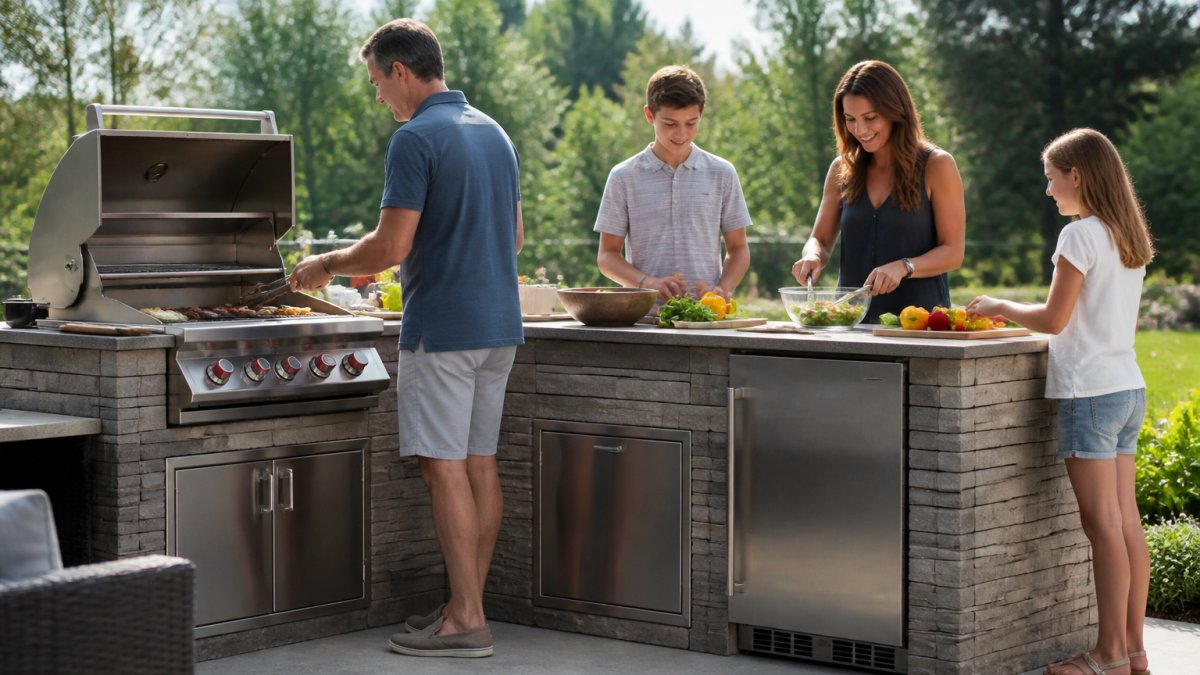
Homeowners who entertain regularly and want a functional outdoor space without major construction find modular systems worthwhile. They're ideal for people who prioritize usability over aesthetics or permanence.
Modular systems also suit those testing the waters. If you've never had an outdoor kitchen and want to see whether you'll actually use it before spending $15,000-$25,000 on a custom build, a modular setup is a lower-risk experiment.
Small backyards benefit from modular flexibility. You can position units to maximize space and adjust the layout if your needs change. Custom kitchens lock you into one configuration.
Modular systems are less ideal for homeowners planning to stay 20+ years, those in harsh coastal climates where corrosion is aggressive, or people who want a showpiece outdoor kitchen that reflects their home's design language.
The Durability Question: Will It Last?
Modular outdoor kitchens built from 304 stainless steel hold up reasonably well in most climates. Stainless steel resists rust better than painted steel or aluminum. The grade matters: 304 stainless is more corrosion-resistant than lower grades (like 430 stainless), but even 304 has limits.
But stainless steel isn't rust-proof, and climate is everything. How long your modular kitchen actually lasts depends far more on where you live than on the materials alone.
Temperate climates (moderate humidity, no coastal salt, mild winters): A modular kitchen with 304 stainless steel cabinets, sealed connections, and regular maintenance can last 12-18 years. Seals and hardware degrade first (5-8 years), but the cabinet structure remains sound. Annual cleaning and drying prevent surface corrosion.
Humid climates (high moisture year-round): Moisture is stainless steel's enemy. In humid regions, surface corrosion (pitting) develops faster, especially around welds and fasteners where water pools. Seals fail sooner because moisture penetrates gaps. Expected lifespan drops to 8-12 years. You'll need to wipe down surfaces after every use and inspect seals quarterly. Some owners in humid climates report cabinet failure or significant rust within 7 years if maintenance is inconsistent.
Coastal climates (salt spray, high humidity): Salt accelerates corrosion dramatically. Even 304 stainless steel develops pitting corrosion within 2-3 years in coastal environments if not maintained obsessively. Fasteners, hinges, and welds corrode faster than flat surfaces. Seals fail within 3-5 years. A modular kitchen in a coastal location requires monthly deep cleaning, annual professional inspection, and replacement of corroded components every 2-3 years. Real lifespan: 5-8 years before major repairs become necessary.
Freeze-thaw climates (winter snow, ice, temperature swings): Repeated freezing and thawing cycles stress connections and seals. Water trapped in gaps expands when frozen, pushing components apart and creating larger gaps. Modular units that aren't anchored to a solid foundation can shift slightly over winter, misaligning drawers and doors. Expected lifespan: 10-15 years, but with more frequent seal and hinge replacement. Seasonal storage (removing the kitchen or covering it heavily in winter) extends lifespan to 15-20 years.
The weakest points in any modular system are the seals, hinges, and connections between units. These wear faster than the main cabinet structure because they flex with temperature changes and absorb moisture. Over 10 years, you'll likely replace door seals (every 3-4 years), drawer slides (every 4-6 years), and possibly some fasteners and hinges (every 5-7 years). In harsh climates, these replacements happen more frequently.
Custom kitchens built from stone countertops, heavy-gauge steel cabinets, and concrete foundations last 20-30 years in most climates because they're heavier, more stable, and less prone to component failure. Stone doesn't corrode. Heavy steel is thicker and resists pitting. Concrete foundations don't shift. Even in coastal climates, a well-built custom kitchen lasts 15-20 years with proper maintenance.
Warranty and replacement parts matter more than you think. Check whether your modular kitchen manufacturer offers replacement seals, hinges, and drawer slides for at least 10 years. If parts become unavailable after 5 years, a failing component forces you to replace an entire cabinet unit instead of just the seal or hinge. This can turn a $200 repair into a $1,500 replacement.
The real durability equation:
- A modular outdoor kitchen that costs $8,000 and lasts 12 years in a temperate climate costs about $667 per year.
- The same kitchen in a humid climate lasting 8 years costs $1,000 per year.
- A custom kitchen that costs $15,000 and lasts 25 years costs $600 per year.
- A custom kitchen in a coastal climate lasting 18 years costs $833 per year.
If you live in a temperate climate and plan to stay 10-12 years, is a modular outdoor kitchen worth the cost, the answer is yes. If you live in a harsh climate (coastal, humid, or freeze-thaw) and plan to stay 15+ years, a custom kitchen becomes the better investment despite higher upfront cost.
Frequently Asked Questions
Is a modular outdoor kitchen cheaper than a custom-built one?
Modular outdoor kitchens typically cost less upfront than fully custom installations. Modular units start around $3,000-$8,000 CAD, while custom-built kitchens often exceed $15,000 CAD. However, modular systems may limit design flexibility and future upgrades, potentially adding costs later if you want to expand or reconfigure the layout.
What are the main disadvantages of an outdoor kitchen?
Key drawbacks include exposure to weather (requiring regular maintenance and protective covers), higher long-term maintenance costs, potential rust and corrosion on metal components, limited cooking season in colder climates, and difficulty relocating once installed. Modular systems address some concerns but still require consistent upkeep to prevent deterioration.
How much maintenance does an outdoor kitchen actually need?
Outdoor kitchens require seasonal cleaning, regular oiling or sealing of metal surfaces, cover use during off-season, and inspection for rust or damage. Budget 4-8 hours annually for basic maintenance. Stainless steel components need weekly cleaning to prevent spotting, and grills require post-use cleaning to extend lifespan and maintain performance.
Does an outdoor kitchen add value to my home?
Outdoor kitchens typically recoup 50-75% of their installation cost at resale, depending on location and quality. Well-maintained modular systems in established outdoor living spaces appeal to buyers, but they're considered a lifestyle upgrade rather than a core home improvement. Climate and local market demand significantly influence resale value.