 comparison
What Is the Best Metal for Campfire Cooking?
Table of Contents
- Cast Iron vs Carbon Steel for Camping: Which Metal Wins?
- How Other Metals Perform Over an Open Fire
- How to Season Campfire Cookware and Keep It Alive
- Best Campfire Cooking Gear for Beginners
- Repairability and Environmental Impact of Cookware Materials
- Comparison Table: Metal Cookware at a Glance
- Conclusion
- Frequently Asked Questions
Last Updated: September 11, 2026
Cast Iron vs Carbon Steel for Camping: Which Metal Wins?
For open-fire cooking, carbon steel wins on weight and cast iron on heat retention, so the right pick depends on how you camp. This guide breaks down what is the best metal for campfire cooking by matching each material to a real use case.
The short answer: carbon steel for backcountry trips where every kilogram counts, cast iron for car camping and base camps where steady heat matters more than pack weight. Stainless steel sits in the middle, aluminum has real limits over open flame, and titanium trades heat control for portability.
Thermal Mass and Heat Retention
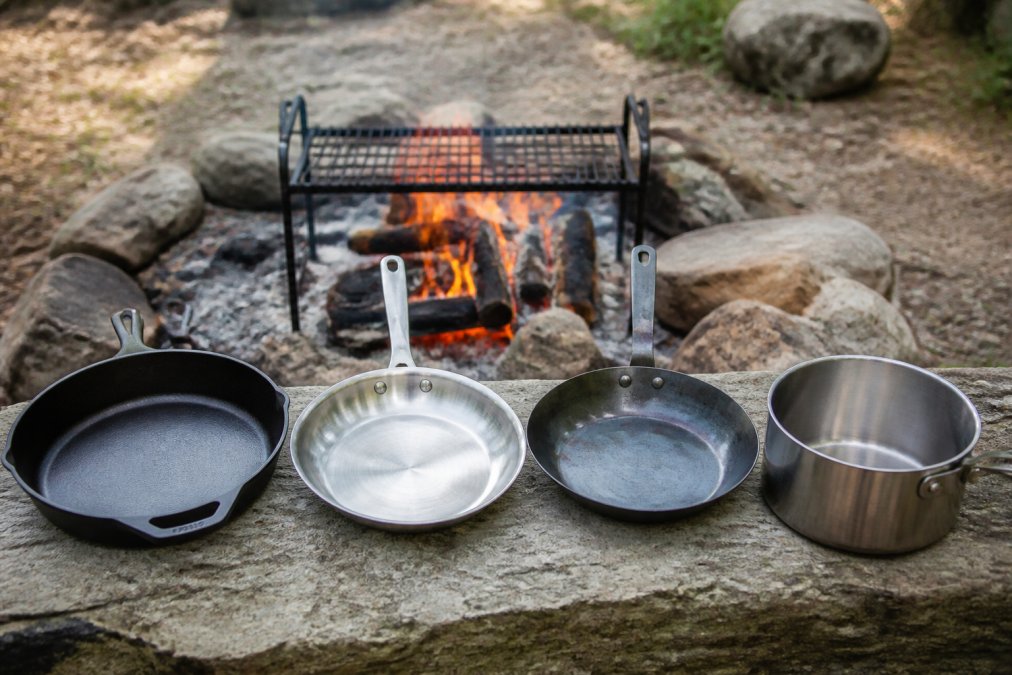
Thermal mass determines how much heat a pan stores and how slowly it releases it. Cast iron has the highest thermal mass of any common camp cookware, which is why a seasoned skillet holds temperature when you drop cold meat into it. Carbon steel heats faster because its walls are thinner, but cools faster once the fire dies down.
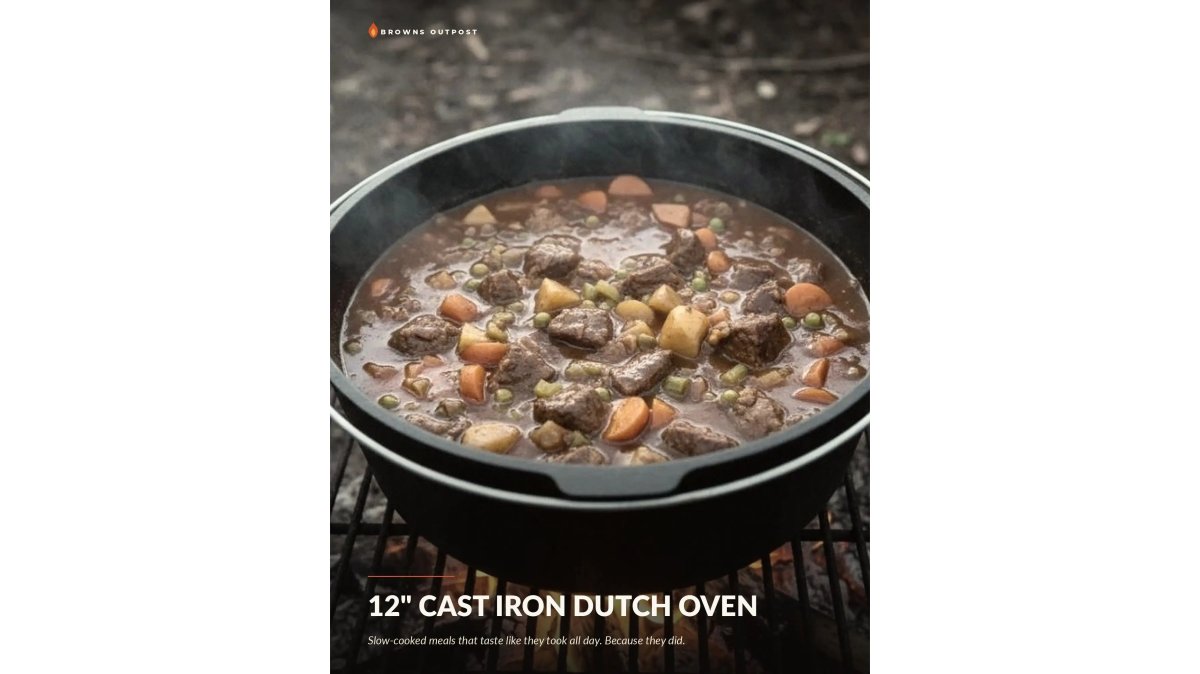
A cast iron dutch oven will hold a simmer for twenty minutes over fading coals; a carbon steel pan will not. The 12" Dutch Oven from Browns Outpost is built for that slow, even heat, with a flanged lid that holds coals for baking bread at camp.

Weight-to-Performance Ratio by Camping Style
Weight-to-performance ratio measures how much cooking capability you get per kilogram carried. Car campers can ignore it; backpackers cannot.
- Car camping and base camps: cast iron is the clear pick. Weight stays in the vehicle, and the heat retention pays off across multiple meals.
- Canoe and short portage trips: carbon steel balances weight and performance well.
- Backcountry and thru-hiking: titanium or thin carbon steel, with cast iron left at home.
A common mistake is buying cast iron for a trip with real distance on foot. The pan works fine; you will not enjoy carrying it.
How Other Metals Perform Over an Open Fire
Stainless steel, aluminum, and titanium all work over a fire to some degree, but each has a failure mode once a fire pushes past 260°C (500°F). A hardwood coal bed routinely sits between 500°C and 650°C (900°F and 1,200°F) at the surface, well above what most cookware was engineered for (fs.usda.gov). That is where material choice stops being about heat distribution and starts being about what ends up in your food.
Stainless Steel: Corrosion Resistance vs Hot Spots
Stainless steel is the most corrosion-resistant common cookware metal, making it appealing for wet, coastal, or rainy trips. The problem is heat distribution: stainless is a poor conductor, so unless the pan has an aluminum or copper core bonded into it, you get hot spots that scorch food in the center while the edges stay cool.
For open-fire cooking, that uneven heating is a real drawback. You can compensate by moving the pan constantly, but that defeats a relaxed camp cook. Single-layer stainless is best treated as a backup pan, not a primary one.
There is also a chemistry angle. The chromium that gives stainless its corrosion resistance forms a passive oxide layer that is stable at normal cooking temperatures, but sustained exposure to extreme coal-bed heat can discolor the surface and, in lower-grade alloys, accelerate the release of trace nickel and chromium into acidic foods. The takeaway is not to fear stainless, avoid parking a thin stainless pan directly on glowing coals for long stretches, and favor pans labeled as a recognized food-contact grade rather than unmarked bargain-bin steel.
Aluminum and Non-Stick Coatings at High Heat
Aluminum has excellent heat conductivity but a low melting point relative to open flame temperatures, and it warps easily under direct fire contact. Bare aluminum also reacts with acidic foods, tomato, citrus, wine, which is why anodized or clad aluminum is the norm for simmering.
Non-stick coatings are the bigger concern. Most are not designed for campfire temperatures, and overheating degrades the coating. Once a polytetrafluoroethylene-based coating breaks down past its rated ceiling, it can release fumes that cause flu-like symptoms in people and are genuinely dangerous to birds, the well-documented reason non-stick pans carry a maximum-temperature warning on the handle.
The practical rule: keep non-stick and bare aluminum off direct flame and coals. Use them on a grate with a moderate fire, or leave them home. For high-heat searing and direct coal contact, cast iron and carbon steel are the safe choices, both are inert at campfire temperatures and neither sheds a coating into your food.
Titanium: Light but Temperamental
Titanium is the lightest metal in the running and effectively rust-proof, which is why it dominates ultralight backpacking kits. The trade-off is heat behavior: titanium conducts heat poorly and has low thermal mass, so it develops fierce hot spots and scorches food unless you keep it moving. It is also expensive relative to carbon steel for the same cooking surface.
Titanium is biologically inert and does not leach at campfire temperatures, so it is one of the cleanest choices for safety. For cooking, it is a fast-boil and rehydrate tool, not a searing pan. Treat it as a weight decision, not a performance one.
The Temperature Threshold That Actually Matters
The most useful number to remember is roughly 260°C to 315°C (500°F to 600°F), the upper range most coated and thin-walled cookware is rated for (Health Canada). A campfire coal bed easily doubles that. Any metal relying on a surface coating, a bonded non-stick layer, or a low melting point will fail somewhere in that gap. Cast iron, carbon steel, and titanium do not, which is why they belong directly on coals rather than on a grate above them.
How to Season Campfire Cookware and Keep It Alive
Seasoning is a layer of polymerized oil bonded to the metal surface that provides a natural non-stick finish and protects against rust. Carbon steel and cast iron need it; stainless and aluminum do not.
Here is the process for how to season campfire cookware:
- Scrub the pan with hot water and a stiff brush. No soap on seasoned iron.
- Dry it completely over heat so no moisture remains.
- Apply a thin coat of neutral oil across the entire surface, inside and out.
- Heat the pan until the oil smokes, then let it cool.
- Repeat two or three times for a new pan.
- After every cook, re-oil while the pan is still warm.
The ANVIL Grill arrives acid-bathed and pre-seasoned with olive oil, so it is ready to cook on out of the box. Re-oiling after each use keeps the surface protected.

Cleaning and Care in Outdoor Environments
Cleaning at camp is simpler than most people expect. Scour the pan with hot water and a brush or a handful of sand, dry it over the fire, and oil it. Skip the soap. Skip the dishwasher, which strips seasoning in a single cycle.
Soot buildup on the outside of a pan is normal and harmless. Scrub it off periodically if it bothers you; the inside surface is what matters.
Best Campfire Cooking Gear for Beginners
The best campfire cooking gear for beginners is a small, forgiving kit: one shallow skillet, one dutch oven or cauldron, and a sturdy adjustable grill. You do not need a full set to start.
Start with the 10" Shallow Skillet at $32.99, it handles eggs, bacon, searing, and sauteing, and is the pan most people reach for first. Add the 10" Cauldron with Reversible Lid at $45.99 for one-pot meals, since the lid doubles as a griddle. For groups, the 16"×9" Griddle at $37.99 cooks pancakes, eggs, and bacon at once across one flat surface.

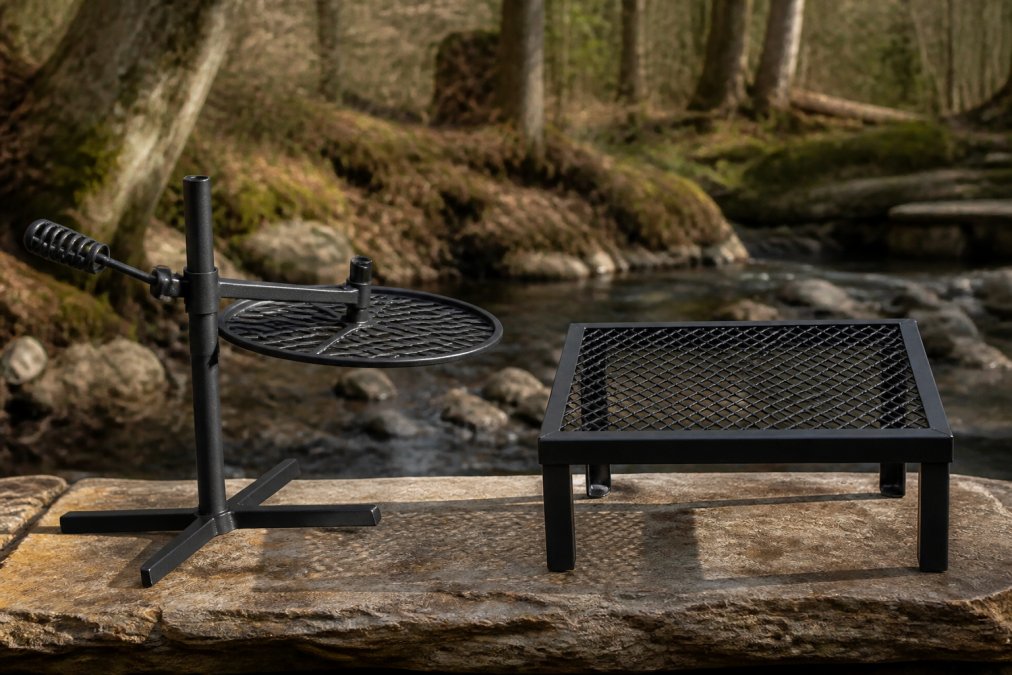
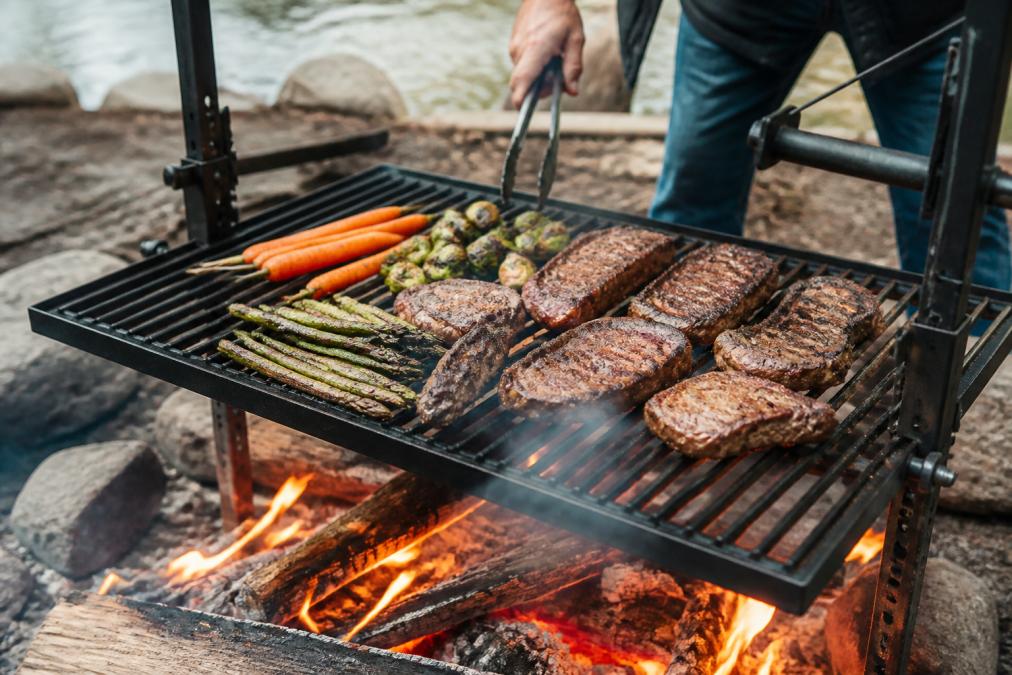
For a single piece that covers grilling and searing over any fire, the Lifetime Warranty ANVIL Grill at $174.99 has 15 x 20 inches of carbon steel surface, adjustable height, and handles up to 40 lb. It stakes into the ground and packs flat.
| Gear | Price | Best For | Why It Works |
|---|---|---|---|
| 10" Shallow Skillet | $32.99 | First pan, breakfasts | Fast sear, low profile |
| 10" Cauldron | $45.99 | One-pot meals | Reversible lid griddle |
| 12" Dutch Oven | $52.99 | Braises, camp bread | Even heat, coal lid |
| 16"×9" Griddle | $37.99 | Group breakfasts | Flat, edge-to-edge surface |
| ANVIL Grill | $174.99 | Grilling over fire | Adjustable height, carbon steel |
Repairability and Environmental Impact of Cookware Materials
Repairability is where cast iron and carbon steel pull far ahead of coated alternatives. A warped or rusted cast iron pan can be stripped, reseasoned, and returned to service; a non-stick pan with a damaged coating is finished. That difference drives both the economics and the environmental footprint of a piece of cookware.
Field Repair: Fixing Warped, Dented, and Rusted Pans
Most camp cookware damage is recoverable with tools you already have. Here is how to handle the common failures.
- Surface rust on cast iron or carbon steel. Scour it back to bare metal with steel wool, a scouring pad, or a handful of sand, dry it over heat, and reseason from scratch. Surface rust is cosmetic, not structural, a rusty pan is almost never a dead pan.
- A warped carbon steel or thin stainless pan. Warping happens when a pan is heated unevenly or quenched in cold water while hot. You can often flatten a mild warp by heating the pan evenly and pressing it flat against a stable surface while it cools, but a severe warp on thin steel is usually permanent. This is one reason to favor heavier-gauge carbon steel for fire cooking.
- A dented cast iron pan. Cast iron is brittle, so do not hammer a dent cold. Gentle, even heating followed by light persuasion with a mallet on a wooden block can ease a minor dent, but a cracked pan cannot be repaired and should be retired.
- A loose or wobbly handle. Re-tighten rivets or screws with the tools on hand; a handle that fails mid-cook is the most common field breakdown and the easiest to prevent with a pre-trip check.
The broader principle: bare-metal cookware is repairable because there is nothing to delaminate. Coated cookware fails at the coating, and the coating is the part you cannot fix.
The Lifecycle Question: Mining, Manufacturing, and End of Life
The environmental comparison is not as simple as "metal good, coating bad," but the end-of-life math is stark. Coated cookware typically ends up in landfill after a few years, while cast iron and carbon steel are handed down across decades. A pan that lasts thirty years spreads its manufacturing footprint across hundreds of meals; one that lasts three does not.
On the production side, titanium carries the heaviest upfront burden, it is energy-intensive to refine and mine, part of why it costs what it does. Aluminum production is also electricity-heavy, though recycled aluminum lowers that footprint dramatically. Cast iron and carbon steel sit in the middle: energy-intensive to make, but made from abundant iron ore and fully recyclable at end of life. Scrap steel and cast iron are among the most recycled materials in the world, so a retired pan re-enters the supply chain rather than sitting in a landfill (Environment and Climate Change Canada).
The practical conclusion is the same one that governs cost: buy one durable bare-metal piece, maintain it, and repair it rather than replacing it. The ANVIL Grill carries a lifetime warranty against manufacturing defects, reflecting how long carbon steel lasts with basic care.
Comparison Table: Metal Cookware at a Glance
| Metal | Heat Retention | Weight | Rust Risk | Best Use Case |
|---|---|---|---|---|
| Cast iron | Highest | Heaviest | High if wet | Car camping, braises, baking |
| Carbon steel | High | Moderate | High if wet | Grilling, searing, backcountry |
| Stainless steel | Low to moderate | Moderate | Very low | Wet trips, backup pans |
| Aluminum | Moderate | Light | None | Grate cooking only |
| Titanium | Low | Lightest | None | Backpacking, fast meals |
The pattern is consistent: the metals that hold heat best are heaviest and need the most care, while the lightest and easiest to maintain give up heat control. There is no single winner across every use case.
Conclusion
Choosing the right metal comes down to matching heat retention, weight, and maintenance to how you cook outdoors. Cast iron and carbon steel handle open fire better than anything else, and both reward regular seasoning with decades of service.
At Browns Outpost, every piece is built from hand-crafted raw carbon steel or heavy cast iron and backed by a lifetime warranty, with free shipping over $75 CAD. The ANVIL Grill adjusts to any fire, the cast iron line covers everything from a quick breakfast to a slow braise, and each piece is designed to outlast the trip and the next one after it. Get started with Browns Outpost and cook over real fire with gear that holds up for a lifetime.
Frequently Asked Questions
Is cast iron or carbon steel better for campfire cooking?
Both work well over an open fire. Cast iron holds heat longer thanks to its thermal mass, which suits stews and baking in a dutch oven. Carbon steel heats faster, weighs less, and responds quicker to temperature changes, making it better for grilling and searing. Your choice depends on whether you prioritize heat retention or portability.
Can you put stainless steel pans directly on a campfire?
Stainless steel can handle direct flame, but it conducts heat unevenly and develops hot spots that scorch food. It also warps more easily under extreme heat than cast iron. For campfire cooking metal, stainless steel works best as a lightweight backup rather than a primary cooking surface over live fire.
Is aluminum safe for cooking over an open fire?
Aluminum conducts heat quickly but has a low melting point compared to cast iron or carbon steel. Bare aluminum can warp or degrade over intense coals. Non-stick coated aluminum is especially risky at high heat because coatings can break down and release fumes. Use aluminum only for low-heat applications or avoid it over open flames.
How do I maintain metal cookware used over a campfire?
Scrape off food residue while the metal is still warm, then scrub with hot water and a stiff brush. Dry immediately over heat to prevent rust, and apply a thin coat of neutral oil once it cools. For cast iron and carbon steel, this re-oiling step rebuilds the seasoning layer and protects against moisture during storage.
Does the thickness of the metal matter for campfire cooking?
Thickness directly affects heat distribution and durability. Thicker walls, like those on a cast iron dutch oven, spread heat evenly and resist warping. Thinner metal heats faster but creates hot spots and dents more easily. For consistent results over a fire, thicker is generally better, though it adds weight to your pack.