 how-to
How to Set Up an Adjustable Campfire Grill in 6 Steps
Table of Contents
- What You Need Before You Set Up an Adjustable Campfire Grill
- Essential Tools for Campfire Cooking
- Step 1: Choose Your Site and Build the Fire
- Step 2: Assemble and Stake the Grill
- Step 3: Set Your Cooking Height and Manage Heat
- Step 4: Cook, Then Cool and Store the Grill
- Best Practices for Open Fire Cooking
- How to Clean Burnt Camping Cookware
- Frequently Asked Questions
Last Updated: September 22, 2026
What You Need Before You Set Up an Adjustable Campfire Grill
An adjustable campfire grill is a cooking grate that slides and locks at different heights over an open fire, so you can control heat without moving the coals. Setup takes about 15 minutes and a few basic items.
Here's what you need before you begin:
- Your adjustable campfire grill and its stake
- A fire source: matches or a lighter
- Tinder, kindling, and split firewood
- A small shovel or trowel
- Heat-resistant gloves
- A bucket of water or sand
- Tongs and a spatula
Essential Tools for Campfire Cooking
Good campfire cooking comes down to three things: the grill, fire safety gear, and a few cooking tools. With an adjustable grill, your tools must work at multiple heights, so choose gear that tolerates being moved over live coals.
The Grill Itself
The grill is the one piece worth spending on. Heavy carbon steel or cast iron holds heat far better than thin steel and resists warping when slid along a hot stake.
Three things to check before you buy:
- Grate thickness. Anything under about 3 mm will flex under a loaded skillet and may bow permanently after a few hot cooks.
- Locking mechanism. A friction collar, a pin-and-hole system, or a notched spindle all work, but each behaves differently. Friction collars are fastest to adjust; pin-and-hole systems are the most secure under heavy loads; notched spindles are the simplest to repair in the field.
- Stake length and diameter. A stake shorter than about 60 cm limits how high you can raise the grate for slow cooking. A thicker stake (12 mm or more) resists bending when you press down with a spatula.
Fire and Safety Gear
Keep these within arm's reach of the fire:
- A bucket of water or sand
- Heat-resistant gloves
- A small shovel for moving coals
- Long-handled tongs
A common mistake is setting these items behind you, then reaching over the flames. Put them to your side, within reach without leaning over the fire.
Cooking and Serving Tools
You don't need much: a spatula, tongs, and one good pan cover most meals. Since you'll move the grate while food is on it, lighter cookware is easier to manage.
Step 1: Choose Your Site and Build the Fire
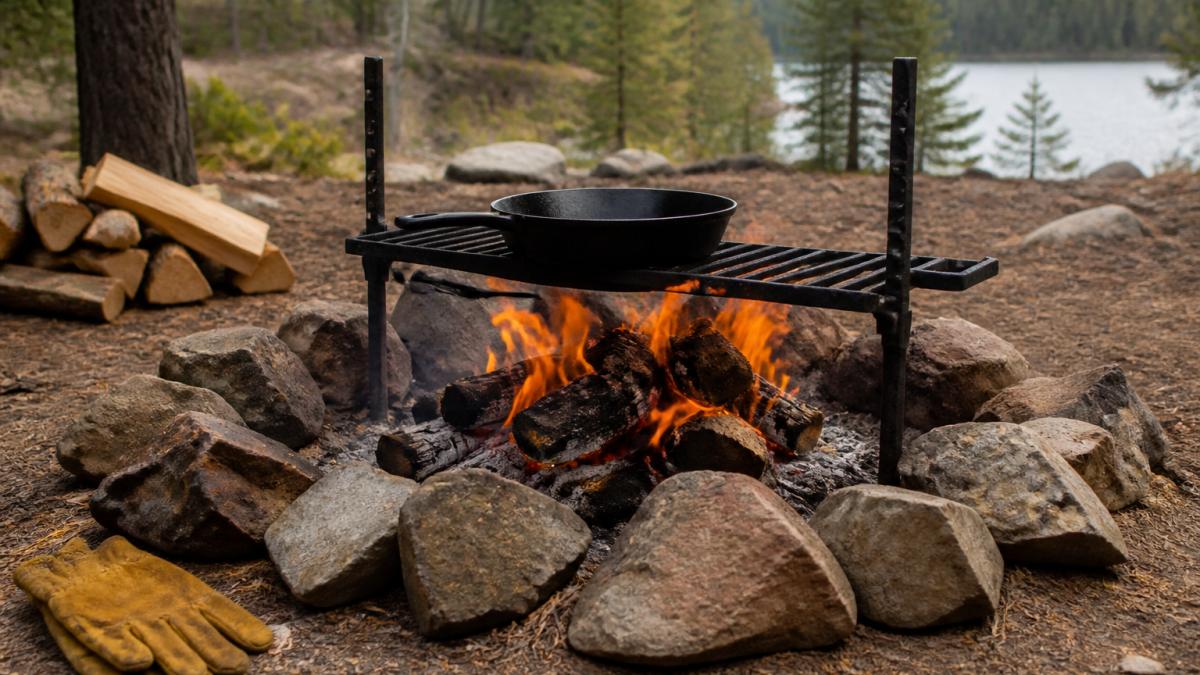
Pick a spot with bare dirt or an existing fire ring, at least 3 metres from tents, trees, and brush. Clear away dry leaves and twigs in a 1-metre circle around the pit.
Step 2: Assemble and Stake the Grill
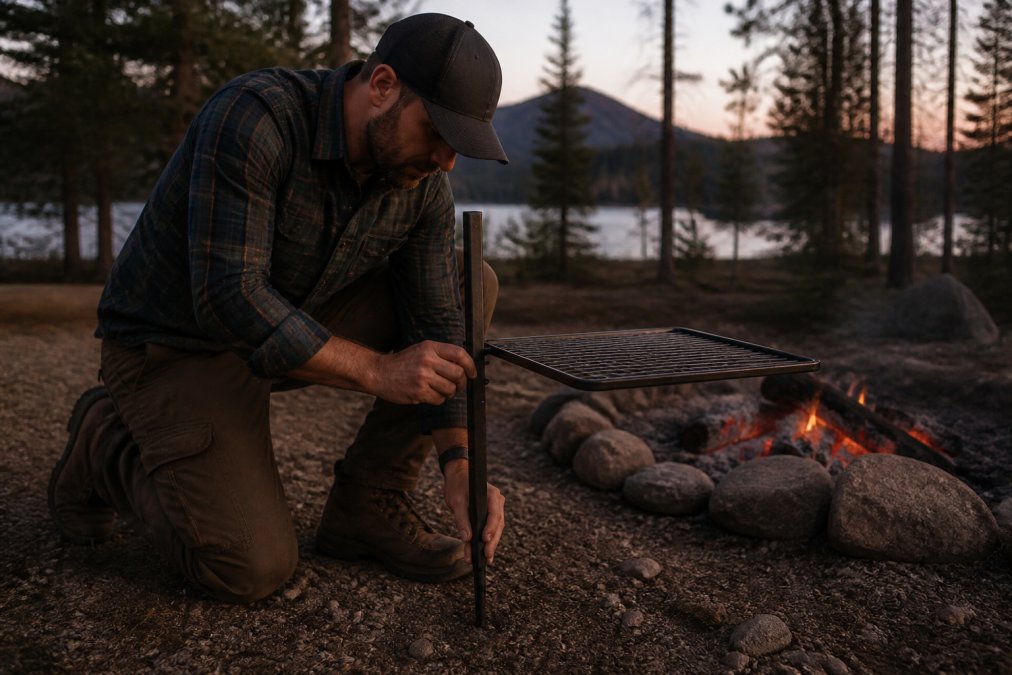
Assembly takes under a minute: slide the grate onto the stake, push the stake into the ground beside the fire, and you're done. No bolts, no tools, no loose parts.
How the Spindle Mechanism Works
The grate slides up and down the stake and locks at whatever height you choose; fewer moving parts means fewer things to break in the backcountry.
Stabilizing on Uneven Ground
Rocky or sloped ground needs extra care: pack dirt or small stones around the base of the stake to firm it up.
Step 3: Set Your Cooking Height and Manage Heat
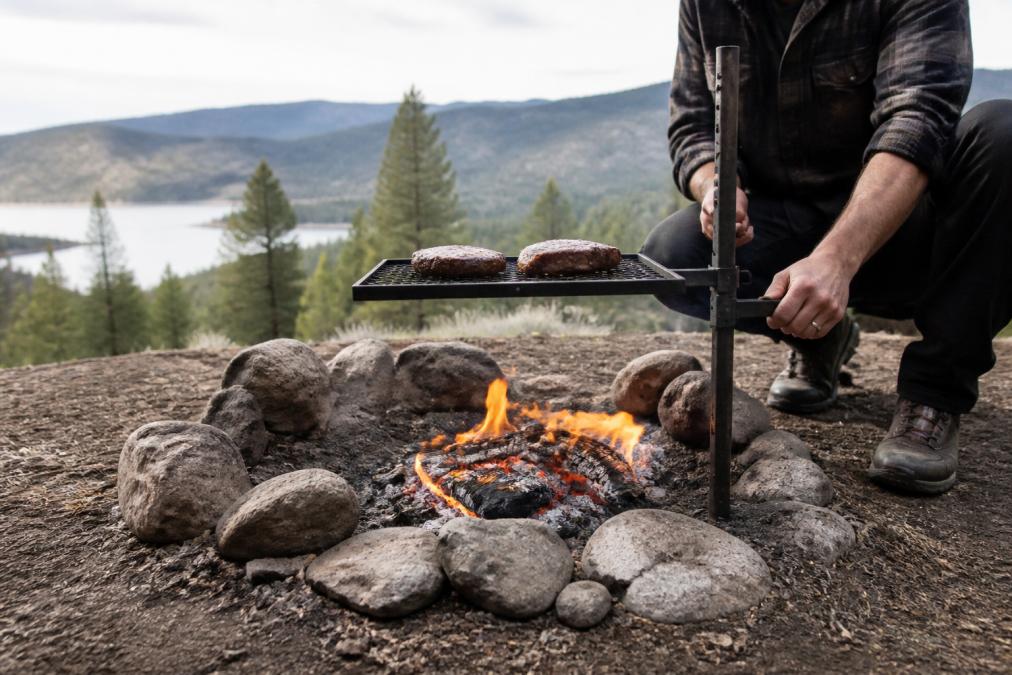
Height is your heat dial: low over the coals gives high heat for searing, high above the fire gives low heat for slow cooking.
| Goal | Grate Height | Heat Level | Best For |
|---|---|---|---|
| Sear | 5-8 cm above coals | High | Steaks, burgers, chops |
| Standard cook | 10-15 cm above coals | Medium | Sausages, vegetables, fish |
| Slow cook | 20-25 cm above coals | Low | Roasts, ribs, stews |
| Warming | 30 cm or higher | Very low | Resting meat, keeping food warm |
Direct vs Indirect Heat
Direct heat means food sits right over the coals, fast, builds a crust, but burns quickly if you look away. Indirect heat means food sits over the side with no coals beneath it, so ambient heat cooks gently, how you cook a whole chicken or roast without torching the outside.
Adjusting While You Cook
Move the grate in small steps, not big jumps. A 5 cm change makes a real difference in cooking speed.
Step 4: Cook, Then Cool and Store the Grill
Cook in batches if you're feeding a crowd. A loaded grate drops in temperature and steams food instead of searing it.
Post-Cooking Cooling and Storage
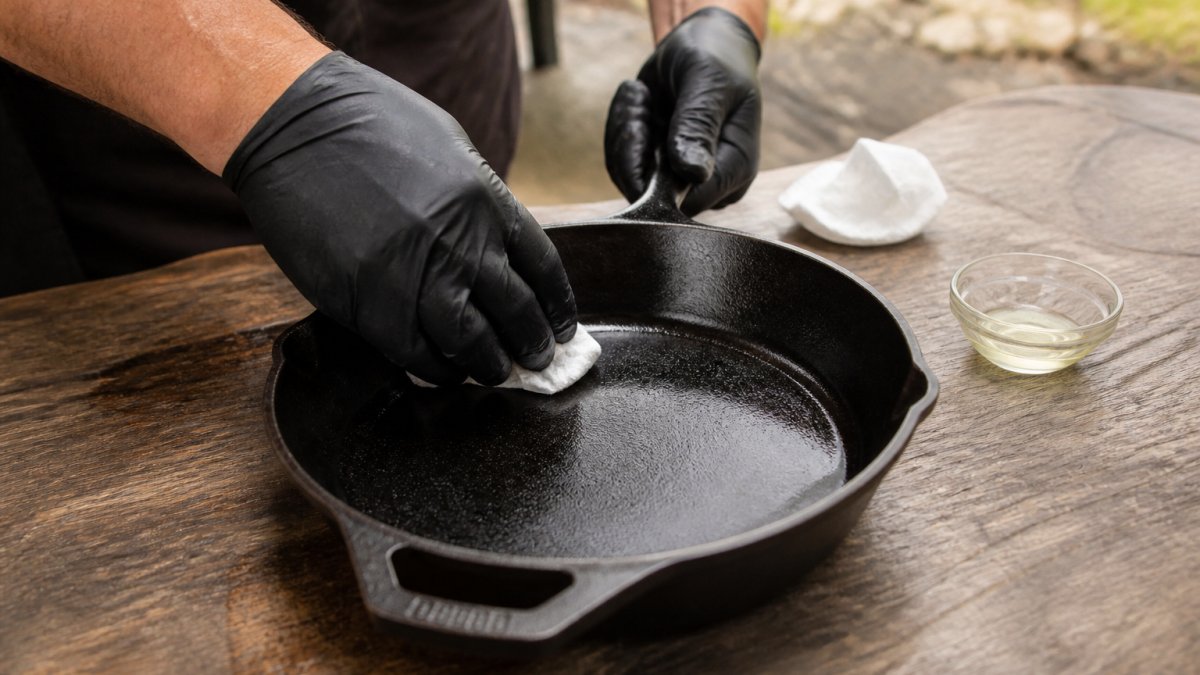
Don't dunk a hot grate in water; the sudden temperature change can warp carbon steel or crack cast iron. Let it cool in place, brush off residue while slightly warm, wipe with a thin coat of oil, and store dry. For transport, let the stake cool fully before packing it against other gear.
Best Practices for Open Fire Cooking
Three things separate a good campfire meal from a frustrating one: wind, weight, and what's under your fire.
Wind Management
Wind steals heat and dumps ash on your food. Build a windbreak from rocks or logs on the upwind side, about 30 cm back.
Weight and Load Limits
Know your grill's limit before you load it. The ANVIL Grill handles 20 kg, enough for a full rear quarter of venison. Spread heavy items across the grate instead of piling them in the centre; a single heavy pan on one edge can tip the whole setup.
Surface Compatibility
Not every surface works. Loose sand won't hold a stake. Solid rock won't accept one.
Best surfaces for staking:
- Packed dirt
- Firm gravel
- Grass over hard soil
- Cracks between rocks
How to Clean Burnt Camping Cookware
Burnt-on food comes off with heat, water, and a stiff brush, no soap, no endless scrubbing. The adjustable grill adds one wrinkle: the grate and stake stay hot long after the fire dies, so cleaning is a cooling-and-handling problem first.
Cooling the Grate and Stake Safely
After the fire is out, the grate and stake can stay hot enough to burn for 20 to 30 minutes, and the stake base, buried in coals, often stays hot longer than the grate itself.
A safe sequence:
- Let the fire die down completely. Don't pour water on live coals just to speed things up.
- Leave the grate on the stake while it cools. Lifting a hot grate by hand is how people get burned.
- After about 20 minutes, test with the back of a gloved hand held a few inches away. If you feel strong heat, wait longer.
- Once the grate is warm but not hot, slide it off the stake and set it on bare dirt or a flat rock, not on grass or a log.
- Pull the stake last. The buried portion cools slowest.
Cleaning the Grate and Cookware
For a burnt pan:
- Fill the pan with water and set it back over low coals
- Let it simmer for 10 minutes to loosen the burn
- Scrape with a wooden spatula or stiff brush
- Rinse with hot water only
- Dry immediately over heat
- Coat with a thin layer of oil
For the grill grate itself, burn off residue over the fire, then brush it clean while warm. A wire brush with a scraper edge handles the corners where the grate meets the stake.
Seasoning the Grate and Preventing Rust
Seasoning is a layer of baked-on oil that protects the steel and keeps food from sticking, and every use adds to it. After each cook, wipe the warm grate with a thin coat of neutral oil and store it dry. Rust comes from moisture, not use; an oiled, dry-stored grate will outlast the camp it was bought for.
Storing the Stake and Grate for Transport
The stake is the part people forget. A warm stake packed against a tent, sleeping bag, or synthetic pack can melt fabric or scorch gear, so let it cool fully, wipe it down, and store it separately from soft items.
A simple storage routine:
- Wipe the stake with an oily rag to keep rust off the buried end.
- Wrap the grate in a cotton towel or burlap sack. This absorbs residual oil and keeps the grate from scratching other gear.
- Store the stake and grate together in a canvas sleeve or a dedicated stuff sack.
- Keep the whole kit out of damp storage between trips. A dry garage shelf beats a damp bin.
Frequently Asked Questions
What is an adjustable cooking grate for a fire pit?
An adjustable cooking grate is a grill surface that slides up and down on a stake or pivoting arm, so you can set it at any height above the fire. Lower positions give intense direct heat for searing; higher positions give gentler indirect heat for slow cooking. The Browns Outpost ANVIL Grill uses a spindle mechanism that locks the grate in place at any position, letting you switch between sear and slow-cook without moving the fire.
How do I safely stabilize my campfire grill on uneven ground?
Drive the stake at least 15 to 20 cm into firm soil, using a mallet or a rock if the ground is packed. If the ground is loose or sandy, look for a spot near a root or rock, or pack soil around the base. Give the post a firm sideways push before cooking. The ANVIL Grill's single-stake design keeps the footprint small, so you can reposition it until it feels solid.
What are the benefits of an adjustable height grill over a fixed grate?
A fixed grate forces you to control heat by moving coals or waiting for flames to die down. An adjustable grill lets you change the distance between food and fire in seconds. That means you can sear a steak at 5 cm above the coals, then raise the grate to 20 cm to finish cooking without burning. It also makes the grill useful over any fire, from a small campfire ring to a full-size fire pit.
How do I clean burnt camping cookware after a cook?
For cast iron and carbon steel, burn off food residue over the fire, then brush the surface clean while it is still warm. For stubborn burnt spots, simmer a little water in the pan or on the grate, then scrape with a wooden spatula. Dry immediately on heat, apply a thin coat of neutral oil, and store in a dry place. Never use a dishwasher, which strips seasoning in one cycle.
Setting up an adjustable campfire grill is simple, but cooking well over fire takes practice. The gear shouldn't be the hard part. Browns Outpost builds the ANVIL Grill from hand-crafted raw carbon steel, with an adjustable design that slides and locks at any height, handles 20 kg, and packs down flat for transport. Every piece comes with a lifetime warranty and free shipping over $75 CAD.
Get started with Browns Outpost and cook over real fire with gear built to last a lifetime.